Alternative Learning System Meaning Explained (2026)
The Alternative Learning System, or ALS, is a parallel learning system that offers a flexible route to basic education for people who cannot attend regular school. This guide explains what it means, who it is for, and how it works.

Alternative Learning System Meaning Explained (2026)
The short version: an Alternative Learning System, usually shortened to ALS, is a parallel learning system that provides a practical alternative to regular classroom schooling. It is designed for people who have not had, or cannot currently access, formal basic education — out-of-school children and youth, adults who left school early, and others whose circumstances make daily classroom attendance difficult or impossible. Instead of requiring learners to fit a fixed school timetable, ALS fits learning around their lives, through flexible, community-based, modular study, and it offers a route to certification that is recognised as comparable to completing basic education.
The term is most closely associated with the Philippines, where the Department of Education (DepEd) runs the ALS programme, and where it is defined in law. But the broader idea behind it — flexible, non-formal learning for people outside the formal system — exists in many countries under different names. This guide explains the meaning of the term in its fullest sense, starting with the Philippine programme that defines it most clearly, and then showing how the same principles apply more widely. If you searched for this phrase because you, or someone you know, left school early and wants a way back into education, the practical sections at the end are written for you.
What Does “Alternative Learning System” Actually Mean?
Break the phrase into its parts and the meaning becomes clear. “Alternative” means it is an option alongside, not instead of, the regular system. “Learning system” means it is organised and structured, not just informal self-study. Put together, the Philippines’ Department of Education defines ALS as “a parallel learning system that provides a practical option to the existing formal instruction.” The word “parallel” is doing important work there: ALS runs alongside formal schooling, covering comparable basic education competencies, but through different methods, schedules, and settings.
That definition also explains what ALS is not. It is not a shortcut, and it is not a lesser qualification dressed up in kind language. Learners are assessed against competencies comparable to those of formal basic education graduates, and those who pass the accreditation process receive a certificate or diploma bearing the DepEd seal. It is not home-schooling in the usual sense either, although it shares the flexibility: ALS is a public programme with facilitators, learning centres, a curriculum, and assessment, organised through the education department and delivered in communities. And it is not the same as adult literacy classes alone, though literacy is part of it: the system covers basic education more broadly, including life skills, livelihood skills, and preparation for further study or work.
The legal foundations of the Philippine programme make the intent explicit. The country’s 1987 Constitution recognises and encourages non-formal, informal, and indigenous learning systems, as well as self-learning and out-of-school study programmes that respond to community needs. The Governance Act for Basic Education, Republic Act 9155, mandates the Department of Education to provide non-formal and informal education to out-of-school children, youth, and adults through ALS. Later legislation, the Alternative Learning System Act, institutionalised the system further, including the establishment of community learning centres. The point of that legal scaffolding is simple: access to basic education is treated as a right, and when the formal system cannot reach someone, the state is obliged to provide another route.
Step 1: Understand Why A Parallel System Is Needed
Formal schooling works well for most children, but it assumes a set of conditions that not everyone has: a school nearby, a family able to support daily attendance, freedom from work or caregiving duties during school hours, and a life stable enough to sustain years of uninterrupted study. When any of those conditions break down, a child may drop out, or may never enrol at all. The reasons recorded for the Philippines’ out-of-school population are familiar across the world: inaccessibility of schools, illness or disability, marriage and family matters, the cost of education and financial pressure, the need to work or look for work, and, in some cases, a lack of personal interest after a poor experience of school.
Once someone has been out of school for a while, returning to a regular classroom is often impractical as well as intimidating. An adult in their twenties or thirties cannot easily sit in a class of twelve-year-olds. A young parent cannot attend school all day and care for a child. A worker who supports a family cannot give up income for years of full-time study. A person in a remote community may have no secondary school within reach at all. The formal system, designed around children attending a building every weekday, simply does not fit these lives. That gap is what ALS exists to fill — not by lowering the bar, but by changing the shape of the learning so that the bar becomes reachable.
This is also why ALS matters beyond the Philippines. Every education system has people it misses, for similar reasons, and every system needs a second chance route. Some countries call it second-chance education, some call it non-formal education, some run it through adult education colleges or community programmes. The names differ, but the problem is the same: how do you give someone who missed formal schooling a credible, flexible way to complete basic education and move on to work or further study? The Philippine ALS is one of the most fully developed answers to that question, which is why it has become the reference point for the term.
Step 2: See Who ALS Is For

The Philippine ALS programme is aimed, in the Department of Education’s own framing, at out-of-school children, youth, and adults — often shortened to OSCYAs — who have not completed basic education. Within that broad group, several categories recur. Out-of-school youth who left school early, whether to work, because of family circumstances, or after falling behind. Adults who never finished elementary or secondary education and now want a certificate for work or further study. Persons with disabilities for whom regular school attendance is difficult. Indigenous peoples and communities whose learning traditions and locations are not well served by the formal system. And people in underserved or remote communities where formal provision is thin or absent.
It is worth pausing on the breadth of that list, because it corrects a common misconception. ALS is not only for teenagers who dropped out, and it is not only for people who cannot read. It serves adults of all ages, people with a range of starting points, and people whose barrier is distance, cost, work, health, or family as much as academic difficulty. A learner might already read well but lack a secondary certificate. Another might need to start with basic literacy. The system is designed to meet learners where they are, rather than requiring them to start again from the same point.
That learner-centred design shows up in how programmes are organised. Learning is community-based, delivered through community learning centres and, in some cases, school-based centres, rather than requiring travel to a distant school. Facilitators — sometimes called ALS teachers or mobile teachers — work with learners in their own communities, and learning can take place in a centre, at home through modules, or in a mix of settings. The emphasis is on the learner’s circumstances: what they need, what they can already do, and what schedule they can realistically sustain alongside work and family life.
Step 3: Learn How ALS Differs From Formal Schooling
The differences between ALS and formal schooling are not about content alone; they are about the whole shape of learning. The table below sets out the main contrasts, and the sections that follow explain why each one matters.
Table:
| Feature | Formal Schooling | Alternative Learning System |
|---|---|---|
| Schedule | Fixed school days and hours, term by term | Flexible, modular, fitted around work and family |
| Location | A school building, usually a classroom | Community learning centres, homes, community venues |
| Pace | Set by the class and the school year | Set by the learner’s progress through modules |
| Assessment | Grades, promotion year by year | Competency-based, through accreditation and equivalency |
| Teachers | Classroom teachers with a class | Facilitators and mobile teachers working with individuals and small groups |
| Learners | Mostly children of school age | Out-of-school youth and adults of varied ages |
Flexibility in scheduling and curriculum is the most obvious difference. ALS learners study at their own pace and at times that suit them, rather than following a fixed timetable. That flexibility is not a luxury; it is the feature that makes participation possible for someone who works during the day or cares for children. It also changes the role of the facilitator: rather than delivering the same lesson to a whole class at the same time, a facilitator guides individual learners through materials, checks understanding, and helps them apply what they learn to real life.
A second difference is the emphasis on life skills and livelihood alongside literacy and numeracy. ALS is anchored, in the Department of Education’s description, on building life skills, enhancing technical-vocational capacities, and providing skill-based training, so that learners finish not only able to read, write, and calculate, but better equipped to earn a living and participate in their communities. That broader scope is why ALS programmes include sessions on life skills, livelihood training, entrepreneurship, and community development alongside academic modules. For an adult learner, that practical orientation is often the point: a certificate matters, but so does the ability to use new skills at work the following week.
A third difference is assessment. Formal schooling promotes learners year by year, largely on the basis of time spent and grades earned in class. ALS assessment is competency-based: what matters is whether the learner has mastered the required skills and knowledge, not how long they sat in a room. That principle is what makes the accreditation process meaningful, and it is also what makes flexible pacing fair. A learner who already has strong skills in one area does not need to repeat it slowly; a learner who needs more time in another area can take it without holding back a class or being held back by one.
Step 4: Understand The Two Main Programmes

Within the Philippine ALS, two main programmes have traditionally structured the offer: the Basic Literacy Programme and the Continuing Education Programme, the latter including Accreditation and Equivalency (A&E). The Basic Literacy Programme is for learners who need to develop fundamental reading, writing, and numeracy skills — the foundation on which everything else rests. It is the starting point for someone with little or no formal schooling, and it is delivered in a way that respects adult learners: practical, contextual, and tied to everyday life, not a repeat of a child’s first school years.
The Continuing Education Programme, including A&E, is for learners who have basic literacy and want to complete elementary or secondary level competencies and gain certification. Learners work through modules covering the learning strands of the ALS curriculum — communication skills, scientific literacy and critical thinking, mathematical and problem-solving skills, life and career skills, understanding the self and society, and digital citizenship, among others, depending on the current curriculum framework. The exact strand names have evolved as the curriculum has been revised, including through the ALS K-12 basic education curriculum, but the principle has remained: cover the competencies of basic education through flexible, modular learning, and assess them through a formal process.
The learning modes used across both programmes reflect the flexibility principle. Modular instruction — printed or digital modules learners work through at their own pace — is central. Face-to-face sessions with facilitators complement the modules, especially for discussion, practice, and assessment. Digital learning is increasingly part of the mix, where connectivity allows it. And sessions on life skills, livelihood, and community development run alongside academic learning, so that the programme serves the learner’s whole life, not just their transcript.
Step 5: From Learning To A Certificate
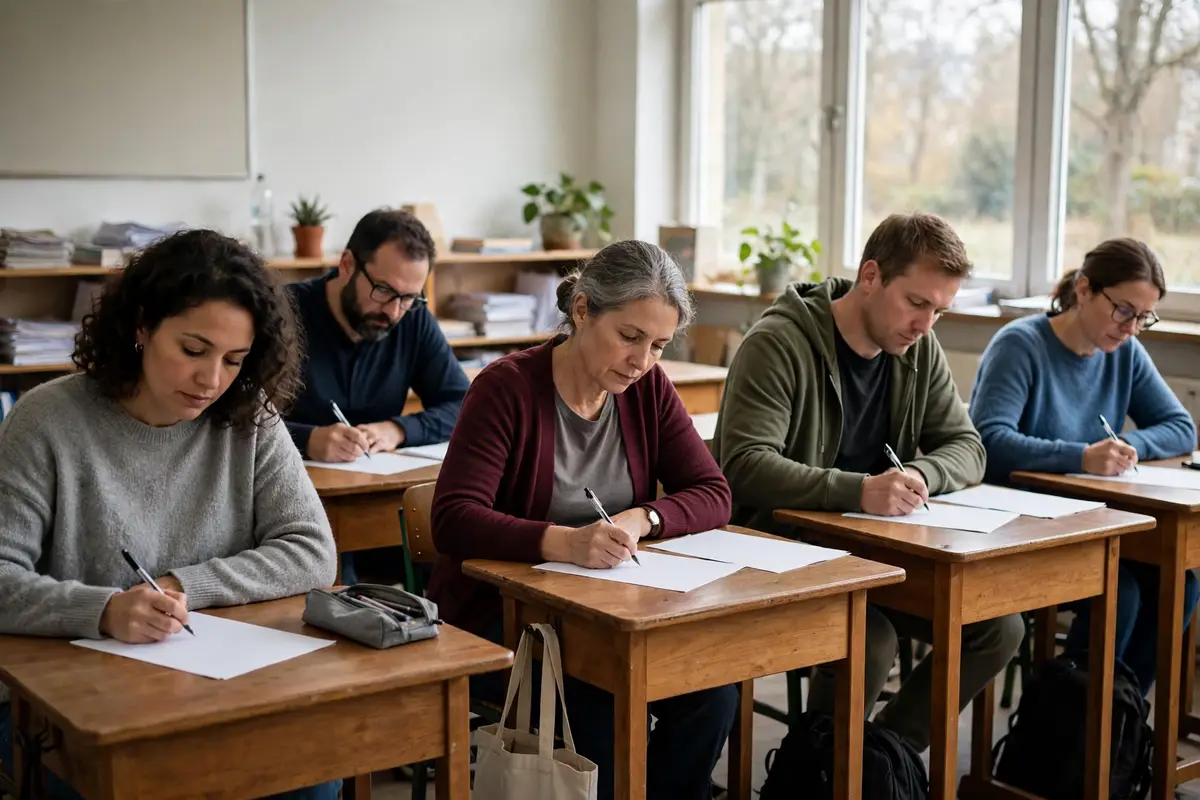
For many learners, the question that matters most is practical: what do I get at the end? Under the Philippine system, learners who complete the ALS programme and pass the Accreditation and Equivalency test receive a certificate or diploma bearing the DepEd seal and the signature of the Secretary of Education, certifying their competencies as comparable to those of formal system graduates. That comparability is the key phrase. It means the certificate is intended to open the same doors a formal elementary or secondary certificate would open: enrolment in junior or senior high school education for those continuing their studies, and eligibility for technical-vocational training and employment opportunities for those entering or re-entering work.
The pathway after ALS depends on the learner’s goals. Some go on to formal schooling, enrolling in junior or senior high school. Others move into technical-vocational education and training, supported by agencies such as the Technical Education and Skills Development Authority. Others use the certificate and the skills they have gained to seek work, start a small livelihood activity, or advance in a job they already hold. The system is also supported by other government agencies — for example, labour and employment bodies are mandated to promote opportunities for ALS passers — which reflects the understanding that a certificate alone is not enough; it needs to connect to real opportunities.
It is important to be honest about the limits of any certificate, including this one. A certificate certifies competencies; it does not guarantee a job, a place in a particular school, or a particular salary. Employers and schools have their own admission and hiring processes, and learners should check the specific requirements of the opportunity they want. What ALS provides is a recognised, credible route to the qualification that those processes ask for, for people who could not obtain it through regular schooling. That is a substantial thing, and it is worth pursuing, but it should be pursued with clear eyes about the next steps after certification.
How To Get Started — Practical Steps For A Prospective Learner
If you are considering ALS for yourself or for someone you know, the practical path starts locally. In the Philippines, the first step is to contact the nearest DepEd division office, school, or ALS community learning centre and ask about enrolment. Bring any school records you have, even if they are incomplete — they help facilitators place you at the right starting point — and be ready to discuss your schedule, so that a realistic learning plan can be agreed. If you are outside the Philippines and searching for a similar route, look for the equivalent in your own country: adult education centres, second-chance programmes, community colleges, and non-formal education providers all offer versions of the same idea, and a local education office can point you to the right one.
Once enrolled, the habits that help most are unglamorous but effective. Set a regular study time, even if it is short, and protect it the way you would a work shift. Work through modules in order, and ask your facilitator when you are stuck rather than skipping ahead and hoping the gap closes itself. Use the life skills and livelihood sessions seriously, not as an optional extra — they are often the parts of the programme that translate most directly into work. And keep your goal in view: whether it is a certificate for a job, entry to further study, or simply the ability to help your own children with schoolwork, a concrete goal sustains motivation through the slow weeks when progress feels invisible.
For families supporting a learner, the most helpful thing is often practical rather than academic: time to study, a quiet corner, encouragement when progress stalls, and patience with a schedule that may look irregular from the outside. Returning to education as an adult takes courage, and the people around a learner can make the difference between finishing and fading out. If you are that person, your support matters more than you may realise.
The Wider Meaning — Why “Alternative” Matters
Stepping back, the phrase “alternative learning system” carries an idea that goes beyond any single programme: that there should be more than one legitimate route to an education. A system with only one route will always exclude someone — the child in a remote village, the teenager who must work, the adult who left school and now wants to return. A system with parallel routes, each held to comparable standards but shaped differently, can reach people the main route cannot. That is the principle behind ALS, and it is why the term has travelled beyond the Philippines into wider discussions of inclusive education.
It also carries a challenge to how we judge education. If a learner completes basic education through flexible, community-based modules rather than through years in a classroom, is that education worth less? The ALS answer is no — provided the competencies are real and the assessment is honest. Competency, not seat time, is the measure. That idea has influenced adult education well beyond one country, and it is worth remembering whenever a non-traditional qualification is dismissed simply because it was earned non-traditionally. What matters is what the learner knows and can do, and whether that has been fairly assessed.
For readers exploring education and career topics more broadly, the practical education guides at The Modern Post cover similar ground in plain language, from study methods to career planning.
FAQs
What is the alternative learning system meaning?
The alternative learning system meaning is a parallel learning system that provides a practical, flexible alternative to formal classroom schooling, for people who have not completed basic education or cannot attend regular school.
What does ALS stand for?
ALS stands for Alternative Learning System. In the Philippines, it is the Department of Education programme for out-of-school children, youth, and adults.
Who is ALS for?
ALS is for out-of-school children, youth, and adults who have not finished elementary or secondary education, including people who left school to work, people with disabilities, indigenous peoples, and people in remote or underserved communities.
Is an ALS certificate the same as a formal school certificate?
ALS passers receive a certificate or diploma certifying competencies comparable to those of formal system graduates, intended to allow enrolment in further schooling and access to technical-vocational training and employment. Specific schools and employers have their own requirements, so check those for the opportunity you want.
How does ALS differ from regular school?
ALS is flexible and modular, community-based, learner-paced, and competency-assessed, rather than fixed-timetable, classroom-based, and year-by-year. It also emphasises life skills and livelihood training alongside literacy and numeracy.
What are the two main ALS programmes?
The Basic Literacy Programme, for foundational reading, writing, and numeracy, and the Continuing Education Programme including Accreditation and Equivalency (A&E), for completing elementary or secondary level competencies and gaining certification.
How do I enrol in ALS?
In the Philippines, contact your nearest DepEd division office, school, or ALS community learning centre about enrolment. Outside the Philippines, ask a local education office about second-chance or adult education programmes, which offer a similar route.
Read Also: Transfer Case Transfer Case: Your 4WD Guide (2026)
Related Stories
MSU SIS Student Portal Guide for Michigan State (2026 Guide)
A plain-English guide to Michigan State University's Student Information System — what it covers, how students use it…

PDF to Word Converter Complete Guide (2026 Guide)
Converting a PDF to Word is easy when you pick the right method, but formatting, scanned pages, and…

Reworder: Complete Step-by-Step Guide to AI Text Rewriting Tools (2026)
A reworder is an AI tool that rewrites text while keeping its meaning. This guide shows how reworders…
1 response