Moldavite Crystal Meaning and Real vs Fake Guide
What moldavite is, where it comes from, what collectors mean by its energy, and the practical checks that help you tell a real piece from a fake one.
Moldavite Crystal Meaning and Real vs Fake Guide
The short version: Moldavite is a naturally formed green glass, known as a tektite, that collectors associate with a meteorite impact in the region that is now the Czech Republic, roughly 15 million years ago according to commonly cited accounts. It is prized for its unusual pitted, sculpted surface and its deep green colour, and it is also one of the most faked stones on the collector market. If you are buying your first piece, the safest approach is to learn what real moldavite looks and feels like, buy from a seller who is open about origin and testing, and treat any dramatic claim about what the stone can do as a belief rather than a proven fact.
That last point matters because moldavite sits at the meeting point of two very different worlds. On one side are mineral collectors and geology enthusiasts who value it as a rare natural glass with a fascinating origin story. On the other side are crystal enthusiasts who describe it as a high-energy stone linked with change, growth, and spiritual work. Both groups are talking about the same material, but they are not always talking about the same thing. This guide keeps those two conversations separate where it matters, so you can enjoy the stone without being misled about it.
If you have come across moldavite on social media, you have probably seen the same pattern: a small, dark green, wrinkled-looking stone held up to the light, a story about feeling a strange warmth or tingling, and a price that seems high for something so small. The attention is understandable. Moldavite does look unlike most stones you will find in a typical crystal shop. It is not polished and smooth like quartz, and it is not bright and jewel-like like peridot. It looks rough, ancient, and a little otherworldly, and that appearance is part of its appeal. The question is not whether it is interesting. The question is whether the piece in front of you is genuine, whether the price is fair for what it is, and whether you are buying it for reasons you are comfortable with.
What Moldavite Actually Is
Moldavite is a tektite, which is a form of natural glass created when a meteorite impact melts earthly rock and scatters the molten material. In the commonly told account, the impact that produced moldavite happened in what is now southern Germany, and the material landed mainly in the region that is now the Czech Republic, especially Bohemia and Moravia. The name itself comes from the Moldau river, known in Czech as the Vltava, which flows through that region. That river connection is a useful memory aid, because genuine moldavite is closely tied to that one geographic area. Stones claimed to come from somewhere else entirely deserve a second look.
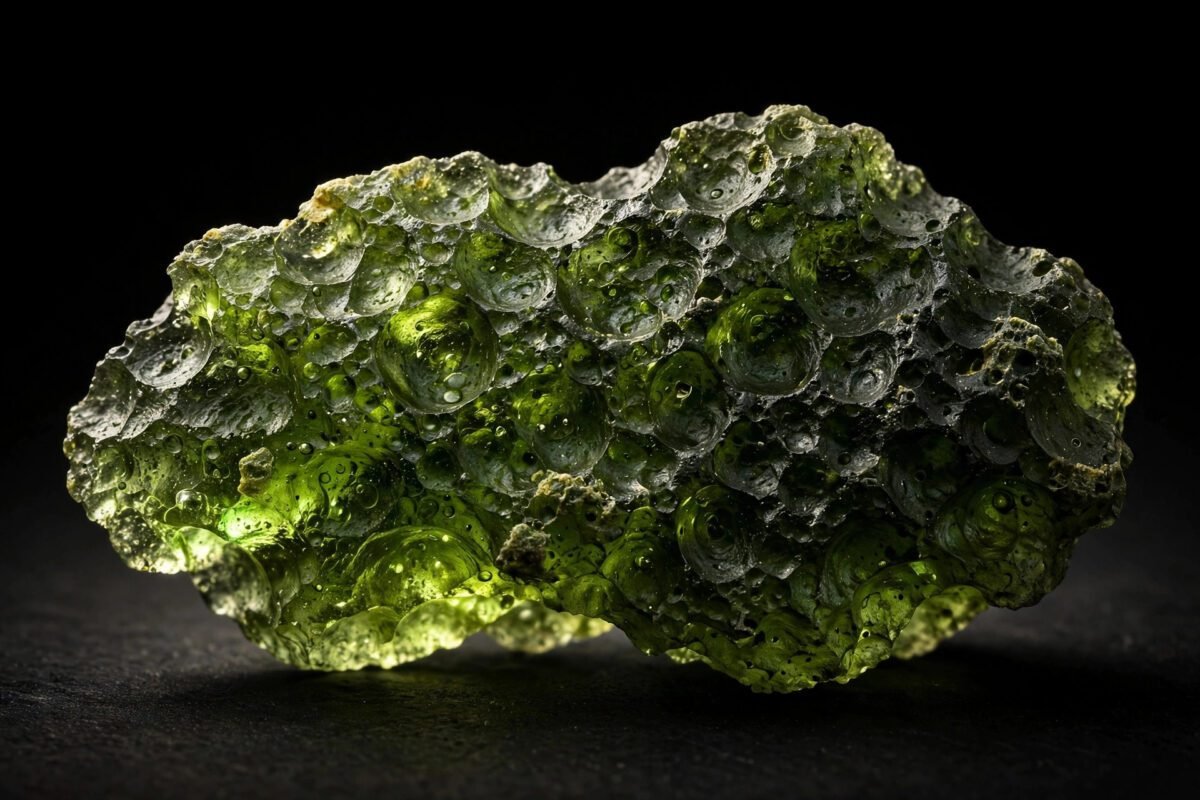
The age usually cited for moldavite is around 15 million years. That figure appears in many geology and collector references, and it helps explain why the stone looks the way it does. It has spent a very long time buried, weathered, and shaped by natural processes. Its surface is typically pitted, grooved, and wrinkled, sometimes described as fern-like or sculpted. Those marks are not damage in the usual sense. They are part of how the glass formed and aged, and collectors often look for them as a sign of natural origin. A piece that looks too smooth, too perfect, or too uniform can be a warning sign, although natural variation means that no single feature proves anything on its own.
Colour is another important clue, and also a source of confusion. Moldavite is green, but not one single green. Genuine pieces range from a pale olive or yellowish green to a deep, dark forest green, and sometimes almost brownish green. When you hold a piece up to a strong light, many genuine stones show some translucency, with light passing through the thinner edges. Very dark pieces may look almost black until light hits them at the right angle. That range is normal. What should raise suspicion is a bright, emerald-like, jewel-toned green that looks like it belongs in a ring setting, or a colour that seems painted on rather than part of the glass itself.
In terms of hardness, moldavite is generally described as falling in the middle range for gem materials, harder than a fingernail and softer than quartz, which means it can be scratched if it is knocked around with harder stones or kept loose in a bag with keys and coins. Collectors usually store it separately, wrapped softly, and handle it with a little care. It is not especially fragile, but it is not a stone to treat roughly either. If you plan to wear it, a protective setting makes more sense than an exposed, high-contact design, and that is true whether you value it as a mineral specimen or as a piece of jewellery.

Why People Are Drawn to Moldavite
People come to moldavite for different reasons, and it helps to be honest about which reason is yours. Some buyers are mineral collectors who want a genuine tektite because tektites are unusual and because moldavite has a clear, traceable origin story. For them, the value lies in authenticity, locality, and condition, in the same way that a fossil or a meteorite fragment has value because of where it came from and what it represents. The stone becomes part of a collection, something to study, display, and talk about.
Other buyers are drawn to the meaning that crystal traditions attach to moldavite. In those traditions, moldavite is often described as a stone of transformation, and people talk about it in connection with change, new chapters, letting go of old patterns, and spiritual growth. Some people report feeling warmth, tingling, or a sense of lightness when they first hold it, a sensation that has become so commonly described online that it has its own nickname. It is important to present this fairly: these experiences are widely reported by enthusiasts, but they are personal and subjective, and they are not established by scientific testing in the way that the stone’s geological origin is. Enjoying that side of moldavite does not require pretending otherwise, and being sceptical about it does not mean the stone itself is fake.
There is also a simpler reason that is easy to overlook. Moldavite is beautiful in a rough, natural way, and it photographs well. Its texture catches light, its colour is unusual, and it looks good in a display case or as a pendant. Many buyers simply like how it looks and how it feels to hold something that formed in such an extraordinary way. That is a perfectly good reason to buy a genuine piece, and it does not depend on any claim about energy or healing. If your reason is aesthetic, you can judge a piece on its appearance and authenticity alone, and you do not need to pay extra for a story.
Understanding your own reason also protects you as a buyer. A seller who knows you are buying for spiritual reasons may be tempted to sell you a story rather than a stone, while a seller who knows you are a collector may focus on locality and condition. When you are clear about what you want, it is easier to ask the right questions, compare like with like, and walk away from a deal that does not feel right. The rest of this guide is built around that practical approach.
The Meaning People Attach to Moldavite
In crystal and metaphysical traditions, moldavite is most often linked with transformation and the heart and higher chakras, depending on the system being used. Writers in that tradition describe it as a stone that supports change, helps a person notice what no longer serves them, and encourages a more open, reflective state of mind. Some people use it during meditation, journaling, or quiet reflection, holding it or placing it nearby as a focus object. Others wear it as a daily reminder of an intention, such as starting fresh or staying open to change. These practices are personal rituals, and their value, for the people who practise them, lies in the focus and intention they bring to a moment, not in any measurable property of the glass.
It is worth saying plainly what moldavite is not, at least in any proven sense. It is not a medicine, it is not a substitute for professional advice or treatment, and it has not been shown to cure, diagnose, or change a health condition. Anyone who tells you otherwise is either mistaken or selling something. That does not make the stone worthless. A meaningful object can matter to a person without being a medical treatment, in the same way that a photograph, a piece of jewellery, or a keepsake can matter. The problem only arises when a meaningful object is sold as if it were something else, with a price to match the inflated claim.
If you do use moldavite as a focus for reflection, it helps to keep the practice grounded. Notice what you actually feel and think, rather than what a video told you that you should feel. Some people feel nothing in particular when they hold moldavite, and that does not mean their stone is fake or that they are doing something wrong. Sensitivity, expectation, mood, and setting all shape an experience, and a quiet response is just as valid as a dramatic one. The stone does not need to perform for you in order to be genuine, and you do not need to perform enthusiasm in order to enjoy it.
Collectors sometimes talk about moldavite in a different kind of meaningful language, the language of rarity and place. Because genuine moldavite comes from a limited area and because the supply of good material is finite, collectors value pieces that are well formed, well preserved, and honestly described. That sense of meaning is tied to the earth and to history rather than to personal energy, but it is no less real to the people who feel it. Both kinds of meaning can coexist, and a single piece can be both a geological specimen and a personal keepsake. The key is not to let one kind of meaning be used to inflate the price of the other without evidence.
Real vs Fake: What to Look For
This is the part of the guide that will save you the most money and frustration, because fake moldavite is common and, in some cases, very convincing at first glance. The most common fakes are made from ordinary green glass, sometimes moulded to imitate the pitted surface of real moldavite, and sometimes simply sold as green glass with a moldavite label. Others are made from different green stones or from glass that has been artificially textured. Some fakes are easy to spot once you know what to look for, while others require testing or an expert opinion. The checks below are practical, not perfect, and they work best together rather than alone.
Start with the surface. Genuine moldavite usually has an irregular, naturally sculpted texture with pits, grooves, and ridges that vary across the piece. The texture often looks organic, almost like a landscape in miniature, with no repeating pattern. Moulded fakes, by contrast, can show repeating patterns, unnaturally even pits, or a texture that looks stamped rather than weathered. Some fakes also have a slightly glossy, almost plastic-like sheen on the surface, while genuine pieces tend to have a more matte, glassy-but-natural finish. Again, variation is normal, so use surface as one clue among several, not as a final verdict.
Next, look at the colour and light. Hold the piece up to a bright light and look through the thinner parts. Genuine moldavite often shows a green glow, sometimes with a slightly olive or mossy tone, and you may see small bubbles or inclusions inside the glass. Those tiny bubbles are a natural feature of tektite glass and are often seen as a positive sign. Fake glass can also contain bubbles, so bubbles alone do not prove authenticity, but the combination of natural colour, uneven texture, and small internal features is more encouraging than a piece that is uniformly bright green and perfectly clear inside. Be especially cautious with pieces that look like cut gemstones, with flat facets and a brilliant shine, because natural moldavite is not normally faceted in that way.
Shape and size also tell part of the story. Natural moldavite comes in irregular shapes, often like small drops, discs, rods, or fragments, and larger pieces are less common than small ones. That scarcity is part of why large, flawless-looking pieces command attention, and also why they deserve extra scrutiny. A very large piece offered at a low price, or a set of many identical-looking pieces, should prompt questions. Natural material varies, so a batch of pieces that all look the same, with the same shape and the same texture, is more consistent with moulding than with nature.
Finally, consider the seller and the story. A trustworthy seller will usually state the locality, describe the piece honestly, show clear photographs from several angles including the back, and be willing to answer questions about how the piece was sourced. A seller who avoids questions, uses only heavily filtered photographs, makes dramatic healing claims, or pressures you to buy quickly is giving you reasons to pause, whatever the stone looks like. Certificates can help, but they are only as reliable as the person or laboratory that issued them, so a certificate from an unknown source should not override what your eyes and common sense are telling you.
Step 1: Examine the Piece in Good Light
Begin with the simplest check, and do it properly. Take the piece into natural daylight or under a strong white light, and look at it from all sides, including the back and the edges. Turn it slowly and notice how the light moves across the surface. Genuine moldavite will usually show variation in colour and texture as you turn it, with some areas lighter or darker than others, and with pits and ridges catching the light unevenly. A fake made from moulded glass may look more uniform as you turn it, with the same pattern repeating or the same sheen across the whole surface.
While you are looking, check the edges and any broken surfaces if the piece has them. Natural glass breaks with a curved, shell-like pattern, and fresh breaks can look sharp and glassy. That alone does not prove authenticity, since ordinary glass breaks in a similar way, but it is part of the overall picture. What you are really doing in this step is building familiarity. The more genuine pieces you look at, in photographs from trusted collectors and, if possible, in person, the easier it becomes to spot something that looks off. Your eye learns the difference between weathered and manufactured, even when you cannot quite put it into words at first.
Step 2: Check Colour, Transparency, and Inclusions
Hold the piece up to a light source and look through it. You are checking three things at once: the colour, how much light passes through, and what you can see inside. Genuine moldavite is usually translucent in thinner areas, with a green tone that may lean olive, mossy, or dark forest green. You may see tiny bubbles, fine lines, or small inclusions trapped in the glass. Those features are consistent with natural tektite formation, where gas and mineral material were caught as the glass cooled.
Be wary of a piece that is either completely opaque in a way that hides all internal detail, or so clear and bright that it looks like a piece of coloured jewellery glass. Also be wary of colour that seems to sit on the surface rather than running through the material, or of a green that is so vivid and even that it looks dyed. Natural variation is your friend here. A real stone rarely looks like it was made to a colour chart, and that slight unevenness is often a reassuring sign rather than a flaw.
Step 3: Assess Texture, Shape, and Weight
Now run your fingers gently over the surface, if the seller allows it, and consider the shape and weight in your hand. Genuine moldavite often feels like glass, cool and smooth in some places and rough in others, with a texture you can feel as well as see. The shape should be irregular and natural, not perfectly symmetrical or repeated. Weight is harder to judge without experience, because glass fakes can be made to a similar weight, but a piece that feels unusually light for its size, or like plastic rather than glass, deserves suspicion.
This is also the moment to compare the piece with reliable reference images. Look at photographs of verified moldavite from museums, geology collections, and established collectors, and compare the texture and form. You are not looking for an exact match, because no two natural pieces are identical, but you are looking for the same family of features: sculpted, pitted, irregular, and green in a natural range. If the piece in front of you belongs to a different family altogether, smooth, symmetrical, and jewel-bright, then it is time to ask harder questions before you spend anything.
Step 4: Ask the Seller the Right Questions
Before you buy, ask where the piece came from, how it was sourced, and whether the seller offers a return if the piece is later shown to be fake. A good seller will answer plainly and will not be offended by careful questions. Ask for photographs in natural light, from several angles, and without heavy filters. Ask whether the piece has been treated, coated, or altered in any way. If the seller cannot or will not answer, that silence is information, and it should weigh in your decision.
Also ask about price in context. Moldavite is not cheap for good material, but price alone is not a guarantee of authenticity, and a high price does not make a fake genuine. Compare prices for pieces of similar size and quality from several reputable sellers, and be suspicious of deals that are far below the usual range, as well as of prices that are far above it without a clear reason. A fair price reflects size, quality, condition, and honest sourcing, not a dramatic story about what the stone will do for you.
Step 5: Get a Second Opinion When It Matters
For a small, inexpensive piece, the checks above and a reputable seller may be enough. For a larger or more expensive purchase, consider a second opinion from an experienced collector, a gemmologist, or a laboratory that can test the material. Testing can look at composition and structure in ways that the eye cannot, and while it may cost something, it can be worth it when the purchase price is significant. Keep any documentation that comes with the piece, including the seller’s description, photographs, and any test results, because that record protects you if you ever resell or need to make a claim.
If you do discover that a piece you bought is fake, act promptly and calmly. Contact the seller, explain what you found, and ask for a refund under their return policy or the platform’s buyer protection. Keep your messages polite and factual, and keep copies of everything. Most reputable sellers would rather resolve a problem than lose their reputation, while a seller who refuses to engage has told you something important about where not to shop next time. Learning from one bad experience, and sharing that experience honestly with other collectors, helps the whole community.
How to Care for Moldavite
Caring for moldavite is straightforward, and it mostly comes down to protecting it from scratches and knocks. Store it separately from harder stones, ideally wrapped in a soft cloth or kept in its own padded box or pouch. Avoid tossing it loose into a bag or drawer where it can rub against metal, keys, or other jewellery. When you clean it, use lukewarm water and a soft cloth, and dry it gently. Avoid harsh chemicals, ultrasonic cleaners, and abrasive materials, which can damage the surface over time. These are simple habits, but they will keep a good piece looking good for years.
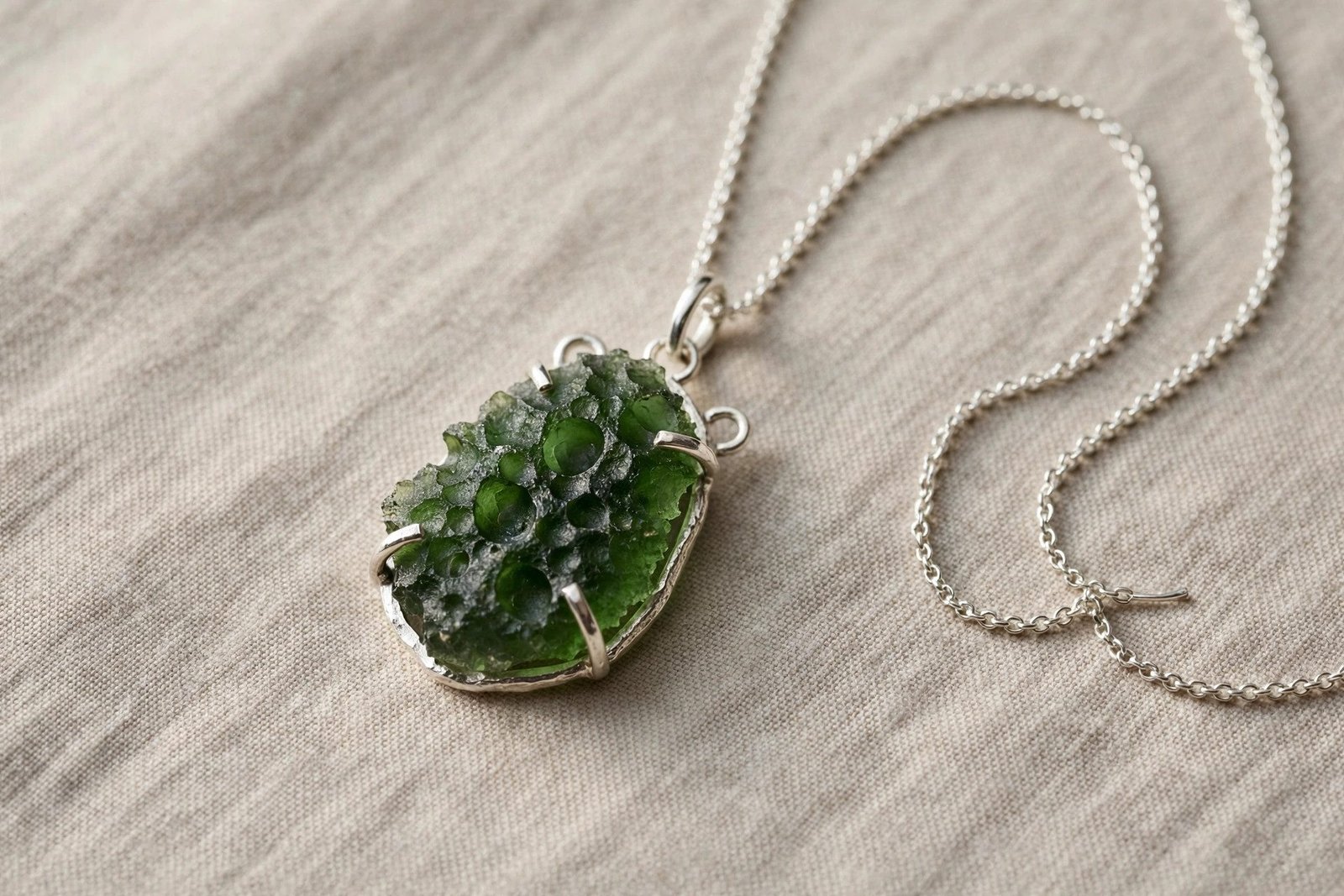
If you wear moldavite as jewellery, think about the setting. A bezel or protective mount that holds the stone securely and shields its edges will serve you better than a high, exposed prong setting that leaves the stone vulnerable to knocks. Take the piece off before heavy work, gardening, or exercise, and be mindful of door frames, countertops, and other hard surfaces. None of this requires special equipment or expensive care products. It just requires the same common sense you would apply to any natural glass or moderately hard stone that you value.
Buying Moldavite Without Regret
The best moldavite purchase is one you still feel good about a month later, when the excitement has settled. That usually means you bought a genuine piece, at a fair price, from a seller you trust, for reasons you can explain without embarrassment. It does not mean you bought the biggest piece, the most expensive piece, or the piece with the most dramatic story attached. Size and story are easy to sell, but they are not the same as quality and authenticity, and they fade quickly if the stone itself disappoints you.
Take your time, especially with a first purchase. Look at many pieces before you buy one, and notice what you are genuinely drawn to rather than what an algorithm keeps showing you. Set a budget before you start shopping, and stick to it. Remember that a smaller genuine piece is worth more, in every sense that matters, than a larger fake, and that waiting for the right piece is part of collecting rather than a failure to buy. The market is not going anywhere, and a patient buyer almost always ends up happier than a rushed one.
It also helps to keep a record of your collection as it grows. Note where each piece came from, when you bought it, what you paid, and any documentation that came with it. That record is useful if you ever want to sell or insure a piece, and it is also a pleasure in itself, a small history of your own taste and learning. Over time, you will find that your eye improves, your questions get sharper, and the fakes that once fooled you become easier to spot. That learning is part of the hobby, and it is worth more than any single stone.
Moldavite at a Glance
| Feature | What to expect from genuine moldavite |
|---|---|
| Material | Natural green tektite glass |
| Origin most often cited | Czech Republic region (Bohemia and Moravia) |
| Age commonly cited | Around 15 million years |
| Colour range | Olive to deep forest green, uneven rather than jewel-bright |
| Surface | Pitted, grooved, sculpted, irregular |
| Transparency | Translucent in thinner areas when held to light |
| Common warning signs | Perfectly uniform texture, bright emerald colour, identical repeated pieces, very low price for a large piece |
FAQs
Is moldavite a crystal or a glass?
Moldavite is a natural glass, a tektite, rather than a crystal in the strict mineral sense. It formed when an impact melted rock and the molten material cooled as glass. Collectors and crystal enthusiasts often still call it a crystal in everyday language, but geologically it is glass, and that distinction helps explain its texture and appearance.
Where does real moldavite come from?
Genuine moldavite is associated with the Czech Republic region, especially Bohemia and Moravia, following a meteorite impact in what is now southern Germany. Stones claimed from unrelated parts of the world, with no connection to that event, should be checked carefully before you buy.
How can I tell if my moldavite is real?
No single check is conclusive. Look for an irregular, sculpted surface, a natural green range rather than a jewel-bright colour, translucency in thin areas, and small natural inclusions. Combine those observations with a reputable seller, clear photographs, and, for expensive pieces, a professional opinion or laboratory test.
Why is moldavite so expensive for its size?
Good moldavite comes from a limited area, larger well-formed pieces are less common, and demand has grown sharply, especially online. Price reflects size, quality, condition, and honest sourcing, but a high price alone does not prove authenticity, so always judge the piece itself as well as the price tag.
Does moldavite really cause tingling or warmth?
Many enthusiasts report sensations such as warmth or tingling when holding moldavite, and those reports are widespread. They are personal and subjective experiences, not scientifically established effects of the stone. Feeling nothing in particular does not mean a piece is fake.
Can I wear moldavite every day?
You can, with a protective setting and sensible care. Store it separately, avoid knocks and harsh chemicals, and take it off for heavy work. A bezel setting that shields the edges is usually a better choice than an exposed setting for daily wear.
For a broader look at how natural materials and collecting hobbies are covered, you may enjoy the lifestyle writing on The Modern Post, and for another take on earth-science topics, the astronomy and science features on Astronomy 101 are worth a browse.
Read Also: 203 Area Code Guide to Southwest Connecticut (2026 Guide)
Related Stories
Rivet: Types, Uses, and How to Choose the Right One
From solid rivets in aircraft and bridges to pop rivets in DIY projects, here is how rivets work,…

Couples Therapy What to Expect First Session (2026 Guide)
A calm, honest walkthrough of the first couples therapy session — the structure, the questions, the ground rules,…

Macallan 12 Beginner’s Guide to a Classic Scotch Whisky
A beginner-friendly guide to Macallan 12 — the two main expressions, what sherry-cask maturation does to the flavour,…
1 response