Telephone Area Code 304 West Virginia (2026 Guide)
Telephone area code 304 covers all of West Virginia. Learn its history, the 681 overlay, dialing rules, and how to spot scam calls.

If a phone number starts with 304, it belongs to West Virginia. That single fact answers the most common question behind this search, but it also opens up a more interesting story. Area code 304 is one of the original telephone area codes in North America, it has covered one entire state for close to eighty years, and it now shares that state with a second code that confuses plenty of callers. This guide explains where 304 reaches, how it began, how the 681 overlay changed dialing, and how to use a 304 number with confidence.
Telephone Area Code 304 West Virginia (2026 Guide)
The short version: telephone area code 304 serves the whole of West Virginia, every one of its 55 counties, from the Northern Panhandle to the Eastern Panhandle. It was assigned in October 1947 as one of the original North American area codes. Since 2009 it has shared the state with area code 681, an overlay code that covers exactly the same territory. Nobody in West Virginia had to change their number when 681 arrived, but everybody in the state now dials ten digits for every local call.
That statewide reach is what makes 304 unusual. Most states are divided into several area code regions, each tied to a city or a corner of the state. West Virginia never split that way. Whether a number belongs to a business in Charleston, a family in Morgantown, or a farmhouse in a rural county, the area code tells you the same thing: West Virginia. The part of the number that narrows things down further is the three-digit exchange that follows the area code, and even that only points to a general exchange area, not a street address.
What Telephone Area Code 304 Covers
Telephone area code 304 covers the entire state of West Virginia. There is no northern 304 region and no southern 304 region. The code reaches all 55 counties and every community inside them, including the state capital, Charleston, and the larger cities of Huntington, Morgantown, Wheeling, Parkersburg, Beckley, Clarksburg, Fairmont, Martinsburg, and Bluefield. It also reaches the small towns and rural exchanges in between, which matters because West Virginia is a largely rural state where a single exchange can serve a wide stretch of countryside.
The state sits in the Eastern Time Zone, so a 304 number runs on Eastern Time, with daylight saving time observed. That detail helps when you are calling from another time zone and wondering whether a business or a friend is likely to be awake. A call placed at noon Pacific Time reaches West Virginia at 3 p.m. Eastern, and a call placed at 9 a.m. Eastern reaches the state at the start of the business day.
| Fact | Detail |
|---|---|
| Area code | 304 |
| State covered | West Virginia, all 55 counties |
| Assigned | October 1947, one of the original North American area codes |
| Overlay code | 681, added in 2009, same statewide territory |
| Time zone | Eastern Time |
| Dialing rule | Ten digits for every local call |
| Largest cities | Charleston, Huntington, Morgantown, Wheeling, Parkersburg |
One point deserves emphasis because it trips people up. An area code shows where a number was issued, not where the phone is right now. A person who got a 304 number in Charleston and later moved to another state can keep that number on a mobile phone for years. Likewise, a business based elsewhere can buy a 304 number to look local to West Virginia customers. The code is a strong hint about a number’s origin, never proof of a caller’s current location. That distinction matters twice over: once when you are trying to identify a missed call, and again when you are deciding whether a call is trustworthy.
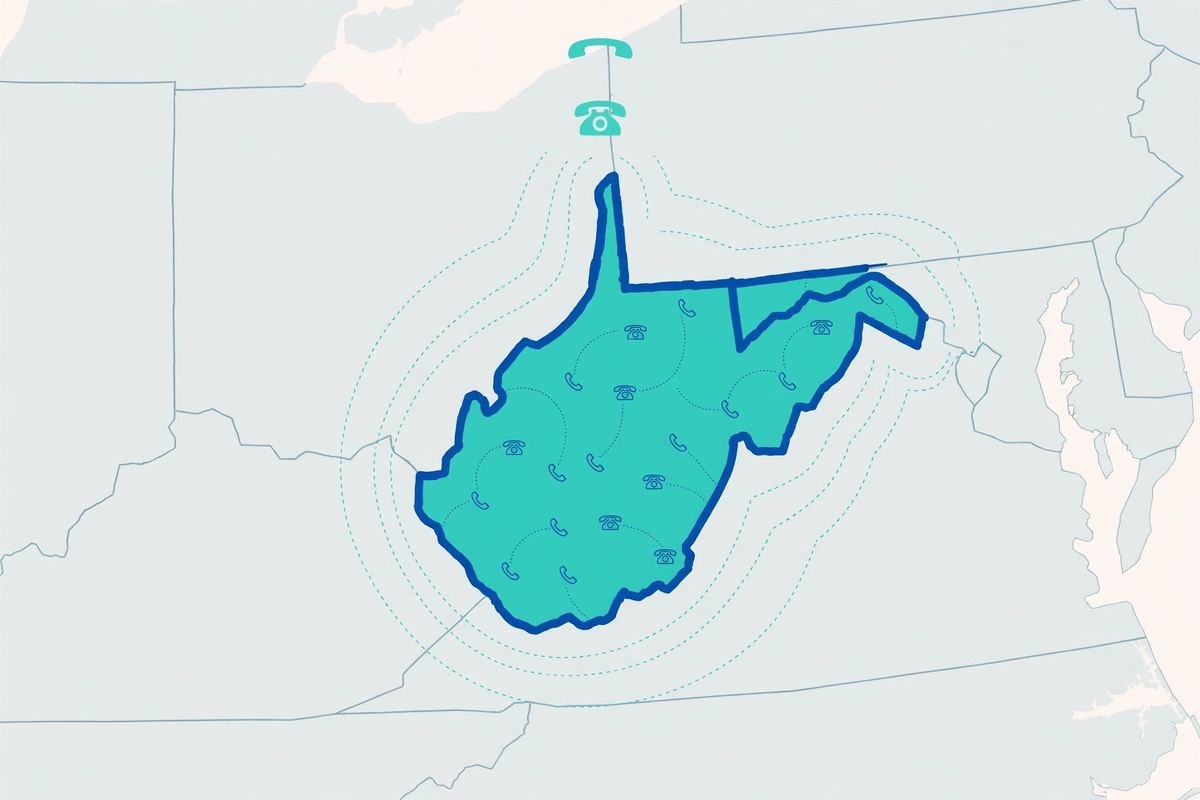
Map of West Virginia as a single telephone area code 304 region.
The History of Telephone Area Code 304
The North American Numbering Plan took shape in 1947, and West Virginia received 304 as one of its 86 original area codes. In that early system, whole states with smaller populations often received a single code, and the middle digit of those codes was zero, which marked them out from codes serving busier regions. West Virginia kept its single code for more than sixty years, a remarkably long run. Telephones spread, businesses grew, and mobile phones arrived, yet the pool of 304 numbers held out far longer than planners in many other states could manage.
By the late 2000s, though, the supply was finally tightening. Mobile phones, fax lines, and business systems had all drawn on the same pool, and regulators had to plan relief. In January 2008, the West Virginia Public Service Commission first voted for a split of the state into two numbering areas. Under that plan, Charleston, Parkersburg, Huntington, Bluefield, and Beckley would have kept 304, while the northern and eastern parts of the state, including Wheeling, Morgantown, Martinsburg, and Clarksburg, would have received a new code. The commission chairman dissented, preferring an overlay instead, and service providers appealed for the same approach. On February 13, 2008, the commission unanimously approved an overlay, the first time an entire state previously served by a single code had taken that route.
The overlay, area code 681, went into service on March 28, 2009, covering exactly the same ground as 304. Ten-digit dialing became mandatory across the state on February 28, 2009, just ahead of the overlay’s launch. The trade-off was straightforward and, for residents, mostly painless. Nobody had to reprint business cards or notify contacts of a new number, because no existing number changed. The price was dialing the area code on every call, even a call to a neighbour on the same street. New numbers issued anywhere in the state may now carry either 304 or 681, depending on availability, so the two codes sit side by side in every town.
Step 1: Dial a 304 Number Correctly
Dialing a 304 number follows the same pattern as any other United States number, with one rule that catches visitors out. Inside West Virginia, you must dial all ten digits for a local call: the area code plus the seven-digit number. A seven-digit call simply does not connect anywhere in the state, no matter how short the distance. From elsewhere in the United States, dial 1, then 304, then the seven-digit number. From outside the United States, dial your country’s international exit code, then 1 for the United States, then 304, then the seven-digit number.
Saving numbers in full international format avoids most dialing mistakes. Store West Virginia contacts as +1 304 followed by the seven digits, and the number will work whether you are calling from Charleston or from another country. This habit also helps when a contact travels, because the stored number stays valid even if the phone itself moves to a different area code region.
Dialing a telephone area code 304 number on a smartphone.
Step 2: Work Out Who Is Calling From a 304 Number
A missed call from a 304 number usually means one of three things: someone in West Virginia, someone who once lived there and kept the number, or a business using a West Virginia number to reach customers there. The area code alone cannot tell you which one it is, and it certainly cannot confirm a caller’s identity. Treat an unknown 304 number the way you would treat any unknown number. If the caller matters, they will leave a message or you can call back on a number you already trust.
Reverse lookups and caller ID apps can sometimes add context, but they are unreliable for mobile numbers and easy to spoof. A scammer can display a 304 number while calling from anywhere in the world, a trick known as caller ID spoofing. The area code on your screen is a claim, not a verified fact. If a caller pressures you, asks for payment details, or claims to be from a bank, a government agency, or a tech company, hang up and contact that organisation directly on its published number. No genuine bank or agency will ask you to move money or read out a security code to prove your identity on an incoming call.
Step 3: Get a 304 Number for a Business
A business that serves West Virginia customers often wants a 304 number because it signals a local presence. Cloud phone systems and voice-over-internet providers sell numbers by state and area code, and 304 remains available through those services, subject to current availability. Some providers may offer 681 instead when 304 inventory in a particular exchange runs low, and for most purposes the two are interchangeable. Customers in West Virginia dial both codes the same way and pay no attention to which one a business uses.
Before choosing, think about how the number will appear to customers. A 304 number carries a sense of history in the state, since it is the original code, while 681 is newer and less familiar to some callers. Neither choice affects call quality or cost in any meaningful way. What matters more is answering promptly, showing the number consistently across your website and listings, and keeping the number active so customers can always reach you on it.
Step 4: Avoid Common 304 Scams and Mistakes
Scam calls are a national problem, and West Virginia numbers are not exempt. Common tricks include fake calls about unpaid bills, prize wins, car warranties, and tech support problems that do not exist. A useful habit is to let unknown numbers go to voicemail. A genuine caller with a genuine reason to reach you will leave a message, and you can then decide whether to call back on a number you have verified independently.
Other everyday mistakes are simpler. Visitors sometimes dial only seven digits out of habit from states without overlays, and the call fails. Others assume a 681 number must be from a different state, when in fact it is the same West Virginia territory. Some people worry that calling a 304 number from another state costs extra, but in practice most mobile plans treat domestic calls the same regardless of area code. If you are unsure about charges, your carrier’s plan details settle the question quickly.
Telephone Area Code 304 and the 681 Overlay Compared
The relationship between 304 and 681 is simple once you see it laid out. Both codes cover the same state, both require ten-digit dialing, and both are issued for landlines, mobiles, and internet-based lines. The only real difference is age: 304 dates from 1947, while 681 dates from 2009. A business in Charleston can hold a 304 line and a 681 line in the same building, and a mobile number issued in Beckley this year is as likely to be 681 as 304, while the landline it replaced almost certainly started with 304.
| Feature | Area code 304 | Area code 681 |
|---|---|---|
| Territory | All of West Virginia | All of West Virginia |
| Introduced | October 1947 | March 2009 |
| Type | Original statewide code | Statewide overlay |
| Dialing | Ten digits locally | Ten digits locally |
| Existing numbers | Never changed by the overlay | New numbers only at launch |
Cities and Regions Inside Telephone Area Code 304
Charleston, the state capital, sits on the Kanawha River and anchors the Kanawha Valley, the most populous part of the state. Huntington, on the Ohio River, anchors the Tri-State area where West Virginia meets Ohio and Kentucky. Morgantown, home to West Virginia University, anchors the north-central region, while Wheeling anchors the Northern Panhandle, a narrow strip of the state between Ohio and Pennsylvania. Parkersburg anchors the Mid-Ohio Valley, Beckley anchors the southern coalfields, and Martinsburg anchors the Eastern Panhandle, within reach of the Washington area. Every one of these places uses 304 and 681 side by side.
That statewide sameness has a practical upside for travellers and newcomers. You never need to look up which code a West Virginia town uses, because the answer is always the same. If you are driving across the state, saving numbers along the way, or setting up services in a new home, the area code question is already settled. The exchange, the three digits after the area code, still varies by locality, but for everyday dialing you only need to remember to include the area code itself.
A West Virginia riverfront skyline, home to many telephone area code 304 numbers.
FAQs
What state is telephone area code 304?
Telephone area code 304 is the area code for the entire state of West Virginia. It covers all 55 counties, including Charleston, Huntington, Morgantown, Wheeling, Parkersburg, Beckley, and Martinsburg.
When was area code 304 created?
Area code 304 was established in October 1947 as one of the original 86 North American area codes. It was the only area code West Virginia needed for more than sixty years, until the 681 overlay arrived in 2009.
Do I need to dial 10 digits for a 304 number?
Yes. Ten-digit dialing is mandatory for all local calls in West Virginia. Dial the area code plus the seven-digit number, even when you are calling someone in the same town or on the same exchange.
What is the difference between area codes 304 and 681?
There is no geographic difference. Area code 681 is a statewide overlay that covers exactly the same territory as 304. New numbers in West Virginia may be issued with either code, and no existing 304 number changed when 681 was introduced.
Is a 304 number a scam if I do not recognise it?
Not necessarily. A 304 number may belong to a genuine West Virginia resident or business, but caller ID can be faked from anywhere. Let unknown calls go to voicemail, and never share payment details or security codes with an incoming caller you cannot verify.
Can I keep my 304 number if I move away from West Virginia?
In most cases, yes. Mobile numbers are portable, so you can usually keep a 304 number after moving to another state. The number will still show 304 to anyone who sees it, even though you no longer live in West Virginia.
Telephone area code 304 is a small piece of telephone history that still does its job every day. It has survived from the earliest days of the North American Numbering Plan to the age of mobile phones and internet calling without ever being split or retired. If you remember three things, you know almost everything you need: 304 means West Virginia, 681 means the same place, and every local call in the state needs ten digits. Keep those rules in mind, save numbers in full, and treat unknown callers with healthy caution, and a 304 number will never catch you out.
Read Also: Baluchi Hound Dog Breed Temperament and Care Guide
Related Stories

Voddler.co.uk: What It Is and How to Use the Site
What is Voddler.co.uk? The honest story of the old Voddler streaming service, what the .co.uk search means today,…
860 Area Code: Location, Cities and How to Dial It
Wondering where the 860 area code is? It covers northern and eastern Connecticut, including Hartford. Learn how to…
Telemetryczny Meaning, Telemetry Explained In English
Telemetryczny is a Polish adjective meaning relating to telemetry, the remote measurement and transmission of data. This guide…
1 response