860 Area Code: Location, Cities and How to Dial It
Wondering where the 860 area code is? It covers northern and eastern Connecticut, including Hartford. Learn how to dial it and spot spam calls.
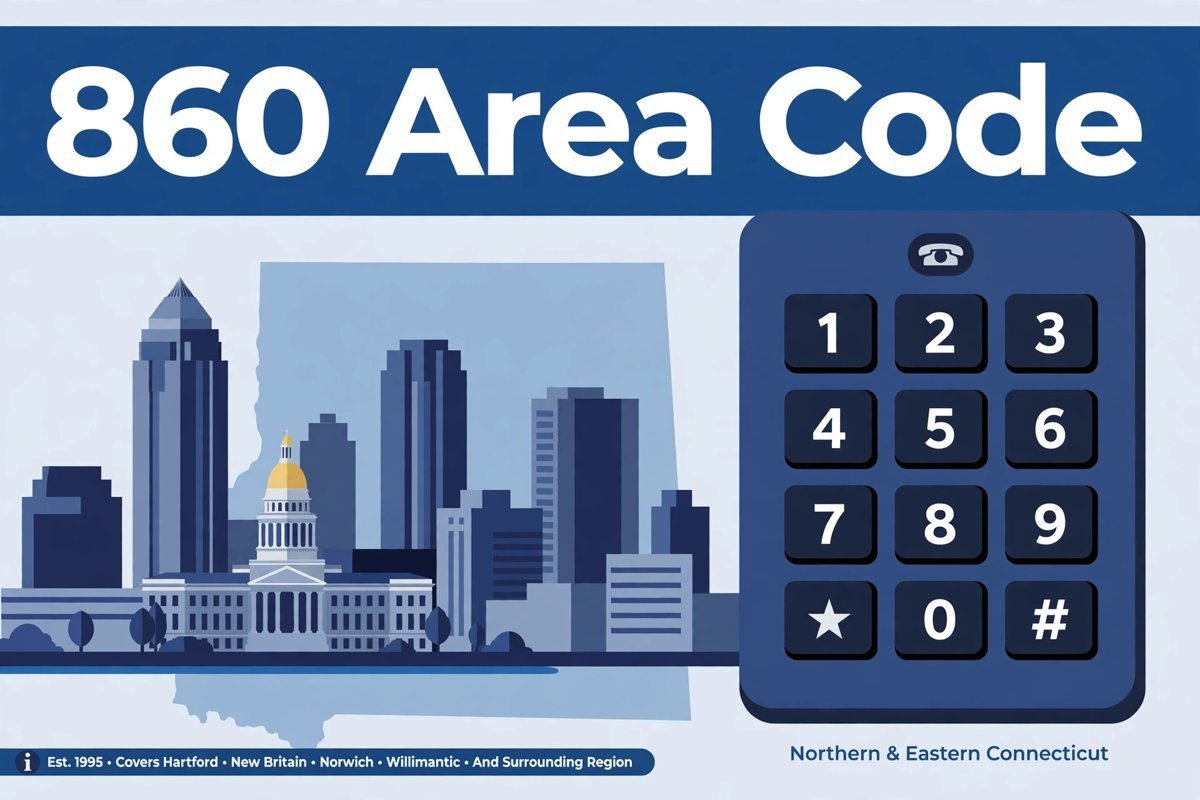
860 Area Code: Location, Cities and How to Dial It
If a number starting with 860 has just flashed up on your phone, or you are about to dial one and want to be sure you have got it right, you are in the right place. The short version: the 860 area code belongs to Connecticut, in the north-eastern United States. It covers the northern and eastern parts of the state, including the capital city, Hartford, and a long list of smaller cities and towns around it.
The short version: 860 is a regular geographic area code, not a toll-free number. Calls to it are charged like any other ordinary United States call, and if you are dialling from outside the country you will need the US country code, +1, in front of it. If an unknown 860 number calls you out of the blue, there is nothing automatically suspicious about the code itself — but as with any unfamiliar number, it is worth a moment of caution before you call back.
In this guide, we will walk through exactly where 860 covers, which cities use it, how to dial it from inside the United States and from abroad, whether it costs extra, and what to do about the spam calls that sometimes seem to come from it. By the end, you will know everything you need to know about this one little three-digit code.
Where Is the 860 Area Code?
The 860 area code serves the state of Connecticut, one of the smaller states in New England. More precisely, it covers the northern and eastern portions of Connecticut. That includes the state capital, Hartford, which sits roughly in the north-central part of the state, along with the Connecticut River valley and the quieter, more rural eastern half of the state.
Connecticut is a small state, and it only has a handful of area codes. The southern and western parts of the state, including cities such as New Haven, Bridgeport and Stamford, use a different code, 203, along with its overlay, 475. The 860 region, by contrast, stretches from the Massachusetts border in the north down through the centre of the state and across to the eastern border with Rhode Island.
It is a varied patch of country. At its heart is Hartford, a city with a long history as a centre of insurance and government, and home to the Connecticut State Capitol. Around it sit old industrial cities, university towns, farming communities and quiet suburbs. Drive east from Hartford and the landscape opens out into rolling hills, forests and small towns, all the way to the Rhode Island line. That whole sweep of the state is 860 territory.
One thing that sometimes confuses people is that 860 is not the only code in this part of Connecticut any more. In later years an overlay code, 959, was added to cover exactly the same geographic area. That means a neighbour in the same town as you might have a 959 number while you have an 860 one, and both are perfectly local. The two codes live side by side, and dialling between them works in exactly the same way.
Which Cities Use the 860 Area Code?
The 860 area code covers a large number of cities and towns. The best-known ones are listed below, but remember this is a general guide rather than an exhaustive directory: new numbers are assigned all the time, and the boundaries of an area code follow telephone exchanges rather than neat lines on a map.
| City or town | What it is known for |
|---|---|
| Hartford | Connecticut’s capital and its largest city in the 860 region |
| New Britain | A former manufacturing centre, sometimes called the Hardware City |
| Bristol | A city in central Connecticut with a long industrial past |
| Manchester | A large suburb east of Hartford with shopping and industry |
| Middletown | A Connecticut River city and home to a well-known university |
| Norwich | A historic city in the eastern part of the state |
| New London | A coastal city on Long Island Sound |
| Torrington | The largest city in the north-western part of the region |
| Enfield | A town on the Massachusetts border, north of Hartford |
| Willimantic | A former mill town in eastern Connecticut |
Beyond these, dozens of smaller towns across northern and eastern Connecticut also use 860 numbers — places like Vernon, Glastonbury, Southington, Groton, Storrs (home to the University of Connecticut’s main campus) and many more. If you are trying to work out whether a particular town is in the 860 area, the simplest test is this: if it is in the northern or eastern half of Connecticut and it is not in the far south-west of the state, there is a good chance its numbers start with 860.
It is also worth remembering that an area code tells you where a number was originally registered, not necessarily where the person holding it is standing right now. People keep their mobile numbers when they move, so an 860 number could belong to someone who now lives in California, and a Connecticut resident might carry a number from somewhere else entirely. The code is a clue about origin, not a live location tracker.
How the 860 Area Code Came to Be
Connecticut was one of the original states covered by the North American Numbering Plan, and for decades the whole state shared a single area code, 203. As the population grew and, more importantly, as fax machines, mobile phones and then the internet multiplied the demand for phone numbers, a single code was no longer enough.
The 860 area code was created in the mid-1990s, when the state was split and the northern and eastern parts took the new code while the south and west kept 203. That is why older Connecticut residents may remember a time when every number in the state began with 203 — and why some long-established Hartford businesses may still be reached on numbers that were converted at the time of the split.
Years later, as numbers in the 860 region began to run short again, the 959 overlay was introduced over the same area rather than splitting the region a second time. An overlay avoids forcing everyone to change their number, which is a big disruption, but it does mean that ten-digit dialling — dialling the area code even for local calls — became the norm in the region. That is now standard practice across much of the United States, and Connecticut is no exception.
Step 1: Dialling an 860 Number From Inside the United States
Dialling an 860 number from anywhere in the United States is straightforward. Simply dial all ten digits: 860 followed by the seven-digit local number. For example, a number written as (860) 555-0134 is dialled exactly as 860-555-0134.
On a mobile phone, you can also save and dial it with the country code in front, as +1 860 555 0134, and it will work just the same. In fact, storing numbers in that full international format is a good habit, because it means the number will still work if you travel abroad and need to call home.
Within the 860 region itself, you still need to dial the area code. Because of the 959 overlay, ten-digit dialling is required even when you are calling someone in the same town. If you dial only the seven-digit number, the call will usually not go through, and you will hear a recorded message telling you to try again with the area code.
Step 2: Dialling an 860 Number From Outside the United States
If you are calling an 860 number from another country, you need to add the United States country code, which is +1. The full format is: your country’s international exit code (or the + symbol on a mobile), then 1, then 860, then the seven-digit number.
So, from the United Kingdom you would dial 00 1 860, followed by the local number. From most of Europe, the same 00 prefix applies. On a mobile phone anywhere in the world, you can simply dial +1 860 and then the number, and the phone works out the rest. The + replaces whatever exit code your country uses, which is why it is the simplest option when you are travelling.
One common mistake is to dial the trunk prefix 1 twice — once as part of the country code and again as if it were a domestic long-distance prefix. You only need one 1 after the + or the exit code. Another is to drop the area code entirely and dial just the seven digits, which will not work from abroad.
Step 3: Receiving Calls From an 860 Number
Receiving a call from an 860 number costs you nothing extra in itself, beyond whatever your normal phone plan charges for incoming calls — and on most modern mobile plans, incoming calls are included. The area code of the caller does not change what you pay.
What matters more is who is calling and why. A legitimate caller from Connecticut — a business, a doctor’s surgery, a school, a friend — will usually be happy to identify themselves and explain the reason for the call. If the caller is vague, pushy or asks for personal information, that is a reason to be careful, regardless of the area code on your screen.
Step 4: Saving and Texting 860 Numbers
Texting an 860 number works the same way as calling it. From inside the United States, send your message to the ten-digit number. From abroad, use the full international format with +1 in front. Most messaging apps handle this automatically when you save the contact with the country code included, so it is worth taking a second to save new Connecticut contacts in the +1 860 format.
If you run a business and you want a local Connecticut presence, an 860 number can be a sensible choice. Customers in the Hartford area tend to trust a local code more than an unfamiliar one, and many virtual phone services now let you choose an 860 number even if your office is elsewhere. Just be honest about where you are actually based — customers appreciate a local number, but they appreciate honesty more.
Is the 860 Area Code Toll-Free?
No, 860 is not a toll-free area code. Toll-free numbers in the United States use codes like 800, 888, 877, 866, 855, 844 and 833. Those are special codes where the business receiving the call pays for it, rather than the caller.
The 860 code, by contrast, is an ordinary geographic code. Calling it is charged at the normal rate for a call to Connecticut under your phone plan. On most modern plans that means it is included in your minutes or charged at a standard domestic rate, but it is never free by virtue of the code alone.
This distinction matters because scammers sometimes try to blur it. If someone tells you that an 860 number is a free helpline or a government hotline, be sceptical and check the claim independently before you share any personal details. Genuine toll-free numbers do not start with 860.
| Dialling situation | What to dial |
|---|---|
| From inside the US | 860 + seven-digit number |
| From a US mobile | 860 + seven-digit number, or +1 860 + number |
| From outside the US | +1 860 + seven-digit number |
| Local call within the 860 area | Still dial all ten digits, including 860 |
| Texting an 860 number | Same as calling, with +1 in front from abroad |
The 860 Area Code and Spam Calls
Like every area code, 860 is sometimes used — or, more accurately, imitated — by spam and scam callers. The most common trick is called neighbour spoofing. A scammer’s system displays a number with your own area code, or with the code of a place you have connections to, so that you are more likely to pick up. The number on your screen may look like a local Connecticut number, but the call may actually be coming from anywhere in the world, and the number shown may not belong to a real person at all.
That is why an 860 number on its own tells you very little about whether a call is genuine. Some spam calls from spoofed 860 numbers pretend to be about car warranties, tax debts, bank accounts or computer problems. Others are simply silent or hang up when you answer, which is often a system checking whether the number is active.
The safest approach is simple. If you do not recognise the number, let it go to voicemail. A genuine caller will leave a message. If you do answer and something feels off — pressure to act immediately, a request for bank details, passwords or gift card codes, or a threat of legal trouble — hang up. No legitimate organisation will ask for that kind of information in an unsolicited call.
You can also reduce the nuisance. Most phones now have built-in spam filtering, and your carrier may offer a free call-blocking service. Reporting spam numbers to your carrier helps too, even though spoofed numbers change constantly and blocking one number rarely stops the problem entirely.
What to Do If You Miss a Call From an 860 Number
First, do not rush to call back. If the caller was genuine, they will usually leave a voicemail or try again. If there is no message, try searching for the full number online — businesses and organisations often have their numbers listed publicly, and a quick search can tell you whether the number belongs to a real company.
If the number is not listed anywhere and no message was left, it is usually safe to ignore it. If you do decide to call back, never share personal or financial information until you are sure who you are speaking to, and if the person who answers claims to be from your bank, a government agency or a well-known company, hang up and call that organisation back on a number from its official website instead.
It is also worth telling older relatives about this habit, because they are often the targets of phone scams. A simple family rule — “if we don’t know the number, we let it ring out and check the voicemail” — prevents a surprising number of problems.
860 Area Code: Common Mistakes to Avoid
- Dialling only seven digits. Ten-digit dialling is required in the 860 region because of the 959 overlay, even for local calls.
- Forgetting the +1 from abroad. Without the US country code, your call will not reach Connecticut at all.
- Assuming 860 is toll-free. It is not — toll-free codes are 800, 888, 877 and similar numbers.
- Trusting the caller ID blindly. Caller ID can be faked, so an 860 number is not proof that the caller is really in Connecticut.
- Calling back unknown numbers straight away. Let unknown callers leave a message first, and verify the number before returning the call.
FAQs
What state is the 860 area code in?
The 860 area code is in Connecticut, in the north-eastern United States. It covers the northern and eastern parts of the state, including Hartford.
What cities are in the 860 area code?
Major cities in the 860 area include Hartford, New Britain, Bristol, Manchester, Middletown, Norwich, New London and Torrington, along with many smaller towns across northern and eastern Connecticut.
Is 860 a toll-free number?
No. The 860 area code is a standard geographic code for Connecticut. Toll-free numbers in the US use codes such as 800, 888 or 877, not 860.
How do I dial an 860 number from the UK?
Dial 00 1 860 followed by the seven-digit number, or simply +1 860 and the number from a mobile phone. The +1 is the country code for the United States.
Do I need to dial 860 for local calls in Connecticut?
Yes. Because the 959 overlay shares the same area, ten-digit dialling is required even for calls within the same town in the 860 region.
Why am I getting spam calls from 860 numbers?
Scammers often spoof local-looking numbers, a trick called neighbour spoofing, to make you more likely to answer. The number on your screen may not be the caller’s real number, and the call may not actually be coming from Connecticut.
What is the difference between 860 and 959?
Both codes cover the same part of Connecticut. The 959 code is an overlay added later to provide more numbers in the same region, so neighbours in the same town can have either code.
Read Also: Telemetryczny Meaning, Telemetry Explained In English
Related Stories

Voddler.co.uk: What It Is and How to Use the Site
What is Voddler.co.uk? The honest story of the old Voddler streaming service, what the .co.uk search means today,…
Telemetryczny Meaning, Telemetry Explained In English
Telemetryczny is a Polish adjective meaning relating to telemetry, the remote measurement and transmission of data. This guide…
Dough Moulding Compound Uses, Properties And Moulding
Dough moulding compound is a thermoset composite shaped under heat and pressure. This guide explains what goes into…
1 response