Armenian: Language, People, Culture and History Guide
What does Armenian mean? A friendly guide to the Armenian language, its unique alphabet, the Armenian people, and their food, traditions and history.
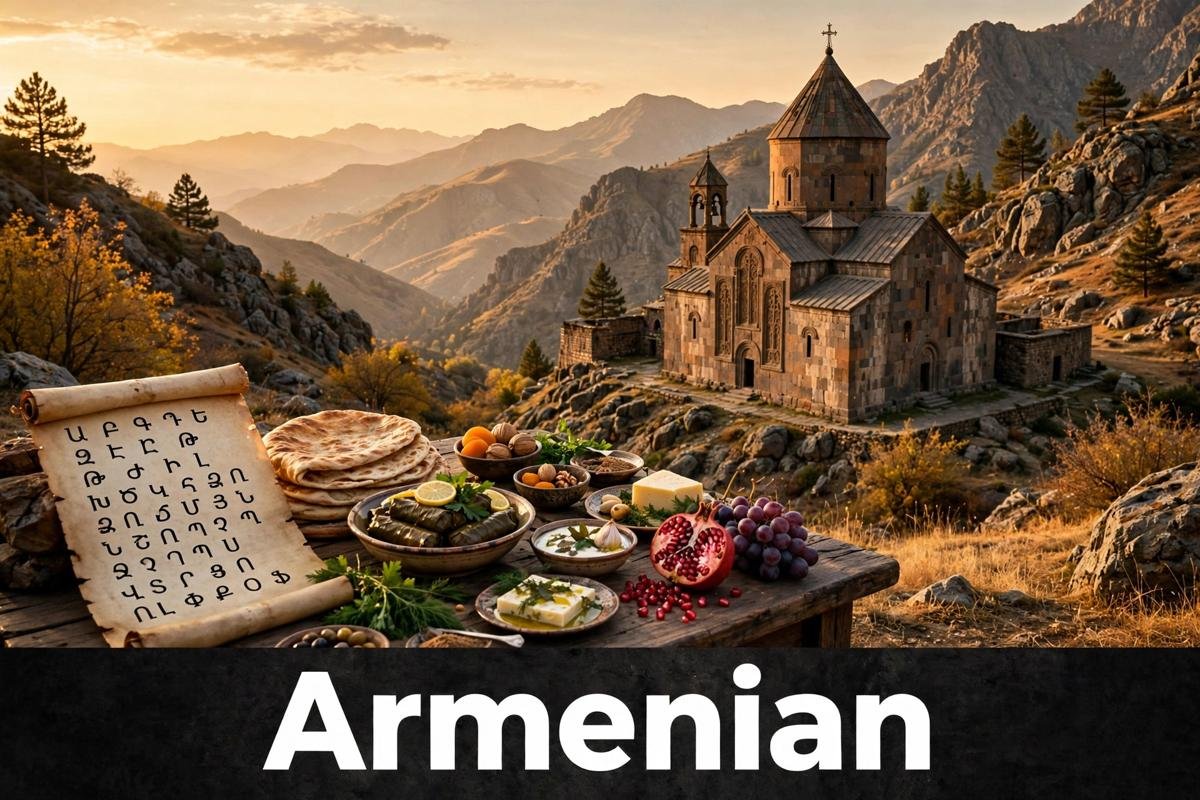
Armenian: Language, People, Culture and History Guide
The word “Armenian” can mean several things at once, and that is part of what makes it interesting. It can describe a language, a people, a culture and a homeland, and most of the time it means all of them together. If you have heard the word in passing — perhaps from a colleague, a restaurant menu, a history book or a piece of music — and wondered what exactly it refers to, this guide will untangle it for you in plain language.
The short version: Armenian is the language spoken by the Armenian people, an ancient people whose homeland sits in the South Caucasus, between Europe and Asia. The language has its own unique alphabet, created more than sixteen centuries ago, and the culture is known for its churches and monasteries, its food, its music and a diaspora — communities of Armenians living all over the world — that has kept those traditions alive far from home.
In this guide we will look at each part of the picture in turn: the language and its alphabet, where Armenian is spoken today, who the Armenian people are, the food and traditions that define the culture, and the long history behind it all, told in broad and well-established terms. No prior knowledge is needed, and no statistics are invented here — where exact numbers are uncertain, we will say so rather than guess.
What Does “Armenian” Mean?
At its simplest, “Armenian” is the adjective for things relating to Armenia, a country in the South Caucasus region, and to the Armenian people wherever they live. So Armenian food is the food of the Armenian people, Armenian history is their history, and the Armenian language is the language they speak.
It is worth making that distinction because the Armenian people and the country of Armenia are not exactly the same thing. The Republic of Armenia is a modern country, but Armenians have lived across a much wider region for centuries, and today large Armenian communities live in countries far from the Caucasus — in Russia, the United States, France, Lebanon, Iran and many others. When someone says they are Armenian, they are usually describing their heritage and identity, whether or not they were born in Armenia itself.
The capital of Armenia is Yerevan, one of the oldest continuously inhabited cities in the world. It is a city of pink stone buildings, wide avenues and a view, on a clear day, of Mount Ararat across the border in Turkey — a mountain that holds a special place in Armenian identity even though it no longer lies within the country’s borders.
The Armenian Language
Armenian is an independent branch of the Indo-European language family. That family also includes English, French, Hindi, Persian and many other languages, but Armenian does not belong to any of the family’s subgroups — it stands on its own, like Greek and Albanian. That independence is one reason linguists find it so fascinating: it has developed along its own path for thousands of years while borrowing words from its neighbours along the way.
For most learners, the first thing that strikes them about Armenian is the alphabet. It looks like nothing else in Europe, with elegant, looping letters that are quite unlike the Latin or Cyrillic scripts. The alphabet was created in the early fifth century, traditionally credited to the scholar Mesrop Mashtots, and it was designed specifically for the Armenian language. It originally had 36 letters, and two more were added later, bringing the total to 39 in the classical form, while the modern Eastern Armenian alphabet in common use has 39 letters and the Western Armenian version is usually counted at 38 — the small difference comes down to how a couple of sounds are treated.
There are two main modern forms of the language. Eastern Armenian is the official language of the Republic of Armenia and is also spoken by Armenian communities in Iran, Russia and elsewhere. Western Armenian developed among the Armenian communities of the Ottoman Empire and is now spoken mainly in the diaspora — in Lebanon, France, the United States and other countries where those communities settled. The two forms are closely related and largely mutually intelligible, though they differ in pronunciation, and in some vocabulary and grammar. Think of the difference as roughly comparable to the gap between two strong regional varieties of the same language, rather than two separate languages.
Armenian is written from left to right, like English. Its punctuation includes a few distinctive marks of its own, including a colon-like mark that functions as a full stop and an exclamation-like mark that serves as a different kind of pause. For a beginner, the alphabet looks daunting, but learners often say that once you learn the letters, Armenian spelling is reassuringly regular — words are generally pronounced as they are written.
Where Is Armenian Spoken?
Armenian is the official language of the Republic of Armenia, where it is spoken by the overwhelming majority of the population. It is also spoken by Armenian communities across the world, a result of centuries of migration and, in the twentieth century, of displacement on a large scale.
The largest diaspora communities are found in Russia, the United States, France, Georgia, Iran, Lebanon, Ukraine and Turkey, with smaller communities in many other countries, including the United Kingdom, Canada, Australia and across the Middle East. In some of these places — Lebanon and parts of the United States, for example — Armenian schools, churches, newspapers and cultural centres have kept the language alive for generations. In others, the language is gradually giving way to the local language, and families may understand Armenian without speaking it fluently, which is a familiar pattern for immigrant communities everywhere.
Estimates of how many people speak Armenian worldwide vary, and honest sources give a range rather than a single figure. What is not in doubt is that the language is spoken by millions of people, that it has a living literary tradition, and that it continues to be taught in schools and universities around the world, including dedicated Armenian Studies programmes.
The Armenian People: A Brief History
Armenian history stretches back a very long way. The Armenian Highlands, the mountainous region where Armenian civilisation developed, have been inhabited for thousands of years, and Armenian identity is usually traced to the ancient kingdom of Urartu and to the later Armenian kingdoms of antiquity, which at their height controlled a substantial territory in the region between the Black Sea and the Caspian Sea.
One of the most important dates in Armenian history is 301 AD, when Armenia is traditionally said to have become the first state in the world to adopt Christianity as its official religion. Whether or not the exact year can be pinned down, the early adoption of Christianity shaped Armenian culture profoundly. The Armenian Apostolic Church, one of the oldest Christian churches in the world, became the guardian of Armenian identity, language and learning through centuries when Armenians were ruled by others.
Over the centuries, Armenia found itself between great empires — Persian, Roman and later Byzantine, Ottoman and Russian — and its borders shifted many times. Periods of independence alternated with periods of foreign rule, and Armenian merchants, craftsmen and scholars travelled widely, establishing communities across the Middle East, Europe and Asia. This long history of trade and movement is part of why the Armenian diaspora is so widespread today.
The twentieth century brought both tragedy and renewal. The Armenian Genocide of 1915, in which very large numbers of Armenians in the Ottoman Empire were killed and many more were driven from their homes, is recognised as a genocide by a large number of countries and by most historians, although the government of Turkey disputes that characterisation. We mention it here because it is central to modern Armenian identity and to the shape of the diaspora, not to argue a contested point in detail — readers who want to explore it further should look at established historical sources.
After a brief period of independence following the First World War, Armenia became part of the Soviet Union for most of the twentieth century, and it regained independence in 1991 when the Soviet Union dissolved. The modern Republic of Armenia is a landlocked country of mountains, ancient monasteries and a fast-developing capital city, building its future while carrying a very long past.
Armenian Culture: Food, Music and Traditions
Armenian culture is warm, generous and deeply tied to family and food. Hospitality is a point of pride: a guest in an Armenian home is likely to be fed well beyond the point of comfort, and refusing food at least once before accepting is part of the friendly ritual.
The food itself is one of the most accessible ways into the culture. Lavash, a thin flatbread baked in a clay oven called a tonir, is so central that it has been recognised by UNESCO as part of Armenia’s intangible cultural heritage. It is used to wrap meats and cheeses, and it is baked in large batches and stored for the winter. Other well-known dishes include dolma (stuffed vine leaves or vegetables), khorovats (barbecued meat, the Armenian version of shashlik), harissa (a slow-cooked wheat and meat porridge, not to be confused with the North African chilli paste of the same name), and a wide range of salads, pickles and cheeses.
Armenian tables are also famous for their fruit: apricots, pomegranates, grapes and peaches all grow well in the country’s sunny climate, and Armenia is often described as a land of apricots — the fruit is sometimes called the Armenian apple in older European writing. Armenian brandy, made from local grapes, is another celebrated product, and Armenian wine-making traditions go back thousands of years.
Music is equally important. The duduk, a double-reed woodwind instrument made from apricot wood, produces a haunting, mournful sound that has become a symbol of Armenian music around the world. It is often heard at weddings, funerals and national occasions, and its sound is instantly recognisable even to people who have never heard of the instrument. Alongside it, Armenian folk dancing, with its line dances and circle dances, remains a living part of celebrations, and Armenian liturgical music — the chant of the Armenian Church — is one of the oldest musical traditions in Christianity.
Churches and monasteries are the most visible expression of Armenian culture in the landscape. Built of local stone, often in remote mountain settings, monasteries such as Geghard, Tatev and Haghpat are masterpieces of medieval architecture, and many are UNESCO World Heritage sites. The khachkar, or cross-stone — an intricately carved stone slab bearing a cross and ornamental patterns — is a uniquely Armenian art form, and thousands of them survive across the region.
Step 1: How to Start Learning Armenian
If this guide has sparked an interest in the language itself, the good news is that getting started is easier than it looks. The first step is the alphabet. Spend a week or two learning the letters and their sounds, and suddenly written Armenian stops being a mystery and starts being readable, even if you do not yet understand the words.
The second step is basic phrases: hello (barev), thank you (shnorhakalutyun — a long word, but one that will earn you smiles), yes (ayo) and no (voch). Armenians are famously encouraging to anyone who tries to speak their language, and even a few words will open doors.
Step 2: Exploring Armenian Culture From Home
You do not need to travel to Armenia to explore the culture. Look for an Armenian restaurant in your city and try lavash, dolma and khorovats. Listen to duduk music online, or to modern Armenian pop and folk artists. Read an Armenian writer in translation — the country’s literary tradition, from medieval historians to modern novelists, is rich and largely undiscovered by English-speaking readers.
If you do get the chance to visit, Armenia rewards travellers with dramatic mountain scenery, ancient monasteries, a welcoming food culture and a capital city, Yerevan, that blends Soviet-era architecture with lively cafes and a growing arts scene. The country is compact, which means you can see a great deal in a short trip.
Armenian Traditions Through the Year
Like many old cultures, Armenian life follows a calendar of festivals and feast days. Easter is the most important religious festival, and it is celebrated with its own traditions, including coloured eggs and special pastries. New Year is a major family occasion, and the Christmas celebration of the Armenian Apostolic Church falls on 6 January, which surprises visitors used to 25 December.
One of the most distinctive festivals is Vardavar, a summer water festival in which people playfully splash each other with water in the streets. Its roots go back to pre-Christian times, and it has survived into the modern day as a joyful, chaotic celebration that delights children and drenches everyone else.
Weddings are another window into the culture. An Armenian wedding is a large, long and joyful affair, with music, dancing, generous food and rituals that vary by region but usually include the blessing of the couple in church, the breaking of bread, and dancing that goes on late into the night. Family is at the centre of it all: extended families are close, grandparents are respected, and family gatherings are frequent and well-fed.
Common Questions About the Word “Armenian”
People sometimes ask whether “Armenian” refers to a nationality, an ethnicity or a language, and the honest answer is that it can be all three. A citizen of Armenia is Armenian in the national sense. A person of Armenian descent living in Los Angeles or Paris is Armenian in the ethnic and cultural sense. And the language they or their ancestors speak is Armenian in the linguistic sense. Context usually makes the meaning clear, and most of the time the different meanings overlap.
Another common question is whether Armenian is difficult to learn. It has a reputation for difficulty, partly because of the unfamiliar alphabet and partly because its grammar is different from English. But it is no harder than many other languages, and its regular spelling and pronunciation are a genuine help. The hardest part, learners say, is finding enough people to practise with — though online communities and language apps have made that much easier in recent years.
| Topic | Key fact |
|---|---|
| Language family | Indo-European, independent branch |
| Alphabet | Created in the early fifth century, unique to Armenian |
| Main varieties | Eastern Armenian and Western Armenian |
| Official status | Official language of the Republic of Armenia |
| Capital | Yerevan |
| Famous instrument | The duduk, made from apricot wood |
| Signature bread | Lavash, baked in a clay tonir oven |
FAQs
What language do Armenians speak?
Armenians speak Armenian, an independent branch of the Indo-European language family. It has two main modern forms, Eastern Armenian and Western Armenian, and its own unique alphabet.
Is Armenian similar to any other language?
Not closely. Armenian is an independent branch of its language family, so it is not mutually intelligible with any other language, though it has borrowed words from Persian, Turkish, Russian and other neighbouring languages over the centuries.
Where is Armenia located?
Armenia is a landlocked country in the South Caucasus, bordered by Georgia, Azerbaijan, Turkey and Iran. Its capital is Yerevan.
What is the Armenian alphabet?
The Armenian alphabet was created in the early fifth century and is unique to the Armenian language. It is written from left to right and, in its modern form, has around 38 to 39 letters depending on the variety.
What food is Armenia known for?
Armenian cuisine is known for lavash flatbread, dolma, khorovats (barbecued meat), fresh salads and cheeses, apricots and pomegranates, and Armenian brandy and wine.
What is the difference between Eastern and Western Armenian?
Eastern Armenian is the official language of Armenia, while Western Armenian developed in the diaspora communities of the former Ottoman Empire. They differ mainly in pronunciation and some vocabulary, and speakers of each can generally understand the other.
Is Armenian a hard language to learn?
It has a reputation for difficulty because of its alphabet and grammar, but its spelling is regular and words are pronounced as written, which helps learners a great deal.
Read Also: 860 Area Code: Location, Cities and How to Dial It
Related Stories

Lord of the Rings T Shirt: Styles, Designs and Buying Guide
A Lord of the Rings t shirt is the easiest way to wear Middle-earth. This guide covers the…

Adidas Men’s Trefoil Essentials Oversized Cotton T-Shirt
The adidas men's trefoil essentials oversized cotton t-shirt pairs a relaxed, roomy fit with the classic Trefoil logo.…

Cyanová And The Colour Cyan Explained In Simple Terms
Cyanová is the Slovak feminine form connected to cyan, the vivid blue-green colour. This guide explains the word,…
1 response