2 Minute Timer: How to Set One + 15 Smart Ways to Use It
2 Minute Timer: How to Set One and 15 Smart Ways to Use It
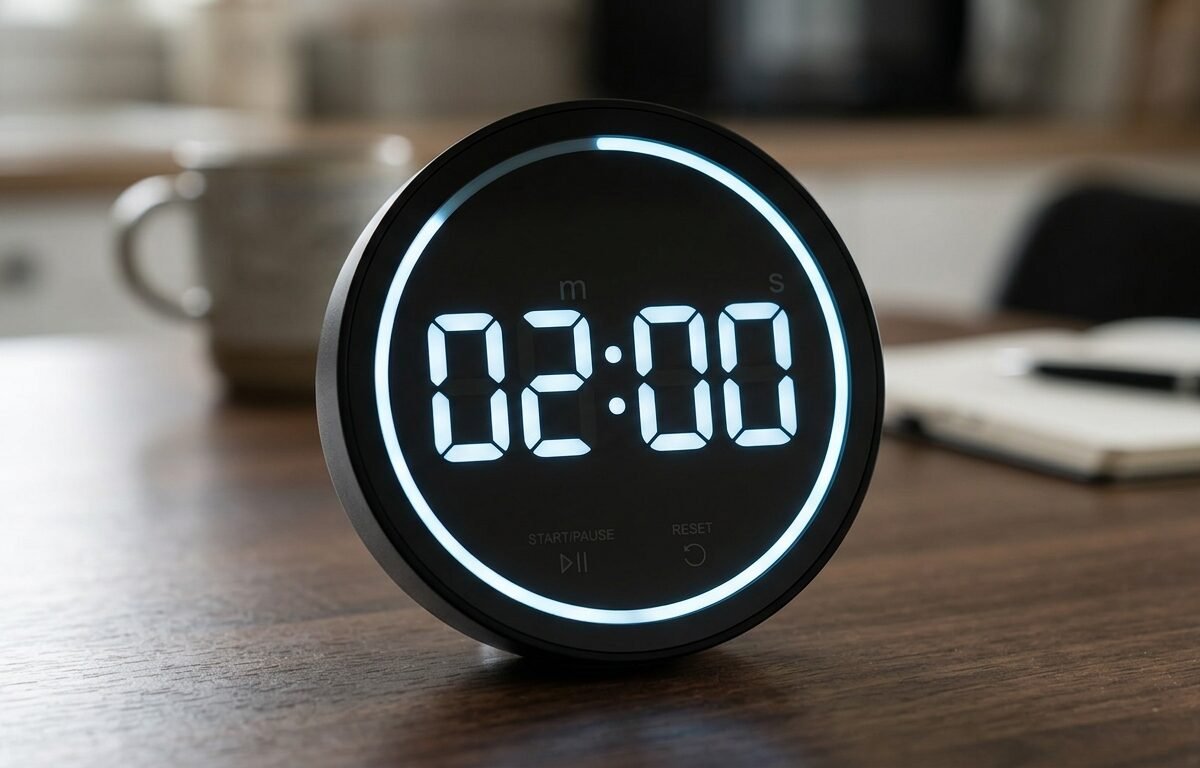
You want a 2 minute timer. Here is the short version: it is a countdown of exactly 120 seconds, and you can start one in about five seconds on the phone that is probably already in your hand. Open your clock app, set 2 minutes, and press start. That is genuinely the whole setup.
The longer version is more interesting. Two minutes sits in a strange sweet spot. It is long enough to actually finish something, and short enough that your brain does not argue with you about starting. This article covers how to set a 2 minute timer on every device you own, why such a short window works so well on human psychology, and fifteen practical uses that go far beyond the kitchen — from the dentist-recommended way to brush your teeth to a productivity trick used by some of the most organized people on the planet.
What Is a 2 Minute Timer?
A 2 minute timer is simply a countdown device that counts down from 2 minutes — 120 seconds — to zero, then alerts you with a sound, vibration, or visual signal. It can be a physical kitchen timer, a phone app, a smartwatch, a voice assistant, or a free website you open in your browser.
Why does this specific length deserve its own guide? Because two minutes shows up everywhere once you notice it. Dentists say it is how long you should brush your teeth. Productivity writers say it is the threshold for doing a task immediately instead of writing it down. Coaches use it for short exercise bursts. It is the shortest unit of time that still feels like “real” time — long enough to matter, short enough to never feel like a burden.
How to Set a 2 Minute Timer on Any Device
Most people searching for a 2 minute timer do not want a lecture. They want the timer. So here are the fastest routes, device by device.
On your phone (fastest)
iPhone: Open the Clock app, tap Timers, set 2:00, and press Start. Or just say, “Hey Siri, set a timer for 2 minutes.” Siri starts the countdown immediately and tells you when it rings.
Android: Open the Clock app, tap the Timer tab, enter 2 minutes, and hit Start. Or say, “Hey Google, set a 2 minute timer.” Google Assistant handles multiple timers at once, so you can run one for the pasta and another for the laundry without conflict.
With a voice assistant
Smart speakers are perfect for this because your hands are usually busy or dirty. “Alexa, set a timer for 2 minutes” works on any Echo device. On a Google Nest speaker, the same phrasing works. The timer rings through the speaker, and you can ask “how much time is left?” mid-countdown.
Online, no app needed
If you are at a computer, several free timer websites let you start a 2 minute countdown in one click — no download, no signup. Some, like the well-known E.ggTimer, even let you bookmark a specific duration so the timer is one click away every time. These are popular in classrooms and offices because you can project the countdown on a shared screen.
On a smartwatch
Apple Watch and most Wear OS watches have a built-in timer with a vibration alert at zero. This is the best option when your phone is in another room or you want a silent alert — during a meeting, for example, where a blaring alarm would be embarrassing.
The old-fashioned way
A mechanical kitchen timer — the twist-dial kind — still works perfectly. No battery anxiety, no notifications, no temptation to check your phone when you pick it up to start the timer. If you keep getting distracted by your own device, the ten-dollar kitchen timer might be the smartest technology on this list.
| Method | Setup time | Alert type | Best for |
|---|---|---|---|
| Phone clock app | ~5 seconds | Sound + vibration | Everyday use, always with you |
| Voice assistant (Siri, Google, Alexa) | ~3 seconds | Sound | Hands-busy moments, cooking |
| Online timer website | ~10 seconds | Sound, tab notification | Classrooms, shared screens |
| Smartwatch | ~5 seconds | Silent vibration | Meetings, quiet environments |
| Kitchen timer | ~3 seconds | Ring or beep | Distraction-free timing |

Why Two Minutes Works: The Psychology of the 2-Minute Rule
Here is the thing about two minutes: nobody is afraid of it. Tell yourself you will clean the garage and your brain starts negotiating. Tell yourself you will do it for two minutes and the negotiation never starts — the cost feels like nothing.
This is the logic behind the famous 2-minute rule from David Allen’s productivity book Getting Things Done. Allen’s rule is simple: if a task will take less than two minutes, do it immediately instead of writing it down, scheduling it, or thinking about it again. Replying to a short email, filing a document, hanging up your coat — doing it now costs less mental energy than tracking it.
But there is a second, quieter version of the rule that matters even more. When a task feels too big to start, commit to just two minutes of it. Open the document and write for two minutes. Put on your shoes and walk for two minutes. Psychologists call this lowering the activation energy — the effort required to begin is usually the whole battle. Once you are moving, momentum tends to carry you past the two-minute mark anyway. The timer is not really a limit. It is a permission slip to start.
That is why a 2 minute timer is less of a clock and more of a psychological tool. It turns “I should do this” into “I am doing this for 120 seconds,” and those are very different sentences to your brain.
15 Practical Ways to Use a 2 Minute Timer
1. Brush your teeth the way dentists actually recommend
This is the single most common reason people set a 2 minute timer, and the one with the most science behind it. Dental associations in the US and UK recommend brushing for two full minutes, twice a day. Most people, left to their own devices, brush for 30 to 60 seconds and miss the gumline and back molars entirely.
The practical method dentists teach: divide your mouth into four quadrants — upper right, upper left, lower right, lower left — and spend 30 seconds on each. Many electric toothbrushes now build this in, with a two-minute timer and a pulse every 30 seconds telling you to move to the next quadrant. With a manual brush, a phone timer does the same job. Two minutes feels surprisingly long the first time you do it properly, which tells you how short your brushing has probably been.

2. Steep the perfect cup of tea
Black tea typically needs two to three minutes of steeping. Too short and it tastes like warm water; too long and it goes bitter. Set a 2 minute timer when the water hits the leaves, and you get a consistent cup every time without hovering over the mug.
3. Time quick cooking steps
Not everything in the kitchen needs twenty minutes. A 2 minute timer covers reheating leftovers evenly in stages, resting a microwaved dish so the heat distributes, or giving a sauce a short, controlled simmer before you check it. It is also the difference between “I’ll just check it in a minute” and actually remembering.

4. Clear micro-tasks with the 2-minute rule
Take David Allen’s rule literally for one week. Every time you notice something that would take under two minutes — answering a text, putting a dish in the dishwasher, booking an appointment — start the timer and do it on the spot. Most people are stunned by how many “I’ll do it later” items are actually 90-second jobs. The pile of small undone things is what makes a day feel chaotic, and two minutes at a time is how you drain it.
5. Do a 2-minute desk reset
Set the timer and tidy only what you can reach without standing up. File the papers, close the tabs, throw away the wrappers, wipe the keyboard. A two-minute reset at the end of the workday means you walk into a clean desk tomorrow morning, and future-you will be disproportionately grateful.
6. Run an inbox sweep
Open your inbox, set two minutes, and archive or delete as fast as you can. No reading newsletters, no composing careful replies — just triage. You will not reach inbox zero, but you will be shocked how many emails die in 120 seconds of focused deleting.
7. Hold a plank or wall sit
A two-minute plank is a genuine fitness milestone — most beginners cannot hold one for 60 seconds. Use the timer as a training target: hold as long as you can, rest, and try to beat your time across the week. Wall sits, where you slide your back down a wall and hold a seated position, work the same way. Two minutes of either will leave your legs or core shaking, which is exactly the point.
8. Do a 2-minute movement burst
Jumping jacks, bodyweight squats, high knees, or just marching in place for two minutes gets your heart rate up and breaks the physical stagnation of desk work. Exercise researchers call these “exercise snacks,” and the evidence suggests short bursts spread through the day add up meaningfully. Two minutes is short enough to do between meetings without needing a shower after.
9. Take a breathing reset
Two minutes of slow breathing is one of the fastest ways to downshift your nervous system. Try this: breathe in for four counts, hold for four, breathe out for four. After about two minutes most people feel noticeably calmer. It is not meditation-app mysticism — slow exhaling activates the parasympathetic nervous system, which is the body’s built-in “stand down” signal. Use it before a stressful call, after an argument, or when your mind will not stop spinning at night.
10. Write a gratitude list
Set the timer and write down everything you are grateful for until it rings. The time pressure is the feature: it stops you from overthinking and forces the honest, unglamorous answers — hot coffee, a working heater, a text from a friend. People who do this regularly report it as one of the highest-return habits for the time invested, and the investment is two minutes.
11. Run cleanup races with kids
“Clean up the living room before the timer rings” turns a chore into a game. Kids who would argue for twenty minutes about tidying will sprint to beat a countdown. The same trick works for getting shoes on, brushing teeth, and getting into the car. The timer becomes the authority figure, which means you do not have to be.
12. Enforce fair turn-taking
Two kids, one swing, endless arguing. A 2 minute timer settles it without a parent playing judge. Each child gets the timer’s full run, then hands over. It works for video game turns, the good crayons, and who picks the bedtime story. Visible, impartial, and impossible to argue with — the timer has no favorites.
13. Do a 2-minute brainstorm sprint
Set the timer and write down every idea you can think of about a problem — no judging, no editing, no crossing out. The deadline kills perfectionism, which is the enemy of brainstorming. Writers use this to break through blocks; teams use it to generate options before a meeting; students use it to start essays. Quantity first, quality later.
14. Practice a short speech or introduction
Job interviews, wedding toasts, and elevator pitches all live in the two-minute zone. Record yourself giving your answer with a 2 minute timer running. You will immediately hear where you ramble, where you rush, and where you run out of things to say at ninety seconds. Two or three timed run-throughs transform a shaky answer into a confident one.
15. Use it as a screen-time circuit breaker
Here is a counterintuitive one: set a 2 minute timer before you open social media. When it rings, you have a decision point — continue scrolling deliberately, or put the phone down. Most mindless scrolling happens because there was never a moment of choice. The timer creates one. You will be amazed how often you choose to put the phone down.
Tips to Make Your 2 Minutes Actually Count
A timer only works if you respect it. A few rules that separate people who get value from the habit from people who just own a timer app:
- Decide the task before you start the clock. “Two minutes of… something” turns into two minutes of deciding. Name the task, then press start.
- Pick an alarm you cannot ignore. A gentle chime is nice for meditation. For chores and workouts, use the most obnoxious sound your phone offers. The alarm is the enforcement mechanism — a polite one gets snoozed.
- Keep the timer visible. A countdown you can see creates urgency; a countdown running in your pocket is easy to forget. Prop the phone up where you can glance at it.
- Do not extend it. The power of two minutes is that it is short and trustworthy. If you routinely let it run to five, your brain will stop believing the deal, and the trick stops working.
- Stack it onto existing habits. Brush your teeth while the coffee brews. Do a wall sit during a phone call. Two-minute habits stick best when they ride on top of something you already do.
Frequently Asked Questions
How many seconds are in 2 minutes?
Exactly 120 seconds. Each minute has 60 seconds, so two minutes is 60 × 2 = 120.
How do I set a 2 minute timer on my iPhone?
Open the Clock app, tap Timers, set 2 minutes, and press Start. Or say “Hey Siri, set a timer for 2 minutes” and it starts immediately.
How do I set a 2 minute timer on Android?
Open the Clock app, go to the Timer tab, enter 2:00, and tap Start. Or say “Hey Google, set a 2 minute timer.” Google Assistant can run several timers at once if you need that.
What is the 2-minute rule?
It comes from David Allen’s book Getting Things Done: if a task takes less than two minutes, do it immediately instead of scheduling it or writing it down. A popular extension: when a big task feels overwhelming, commit to just two minutes of it to get started.
Why do dentists say to brush for 2 minutes?
Two minutes gives you enough time to clean all tooth surfaces — front, back, and chewing surfaces — including the gumline and back molars that most people rush past. Dental associations recommend two minutes, twice a day, and studies on brushing time have found plaque removal improves significantly when people brush the full two minutes instead of 30 to 60 seconds.
Can I use a 2 minute timer online for free?
Yes. Multiple free timer websites offer a one-click 2 minute countdown with an alarm, no download or signup required. Some let you bookmark the timer so it is always one click away.
Is a 2 minute workout actually useful?
As a standalone workout, no — two minutes will not replace regular exercise. But as a movement break, a plank challenge, or a way to break up eight hours of sitting, it is genuinely useful. Short bursts of activity spread through the day are far better than zero, and two minutes is short enough that people actually do it.
Can a 2 minute timer help with anxiety or stress?
It can help as a container, not a cure. Two minutes of slow breathing gives your nervous system a chance to settle, and the timer gives an anxious mind something concrete to focus on instead of spiraling. It is a useful reset button for acute stress — not a treatment for anxiety disorders, which deserve professional support.
Read Also: Powerball Drawing: The Complete Guide to Schedule, Results, How to Play & Winning Odds