Neighbourhood Action Group Explained For Residents
A Neighbourhood Action Group, or NAG, is a UK volunteer group where residents, police, and local organisations agree on the top issues in an area and act on them together. This guide explains how it works and how to get involved.

Neighbourhood Action Group Explained For Residents
The short version: a Neighbourhood Action Group, usually shortened to NAG, is a UK volunteer group that brings residents, the police, the local council, and other local organisations together to agree on the issues that matter most in a neighbourhood — and then do something about them. It is not a residents’ association, it is not a neighbourhood watch scheme, and it is not a council committee. It sits between all three: a working group, coordinated by the police, where the community itself sets the priorities and shares the job of tackling them.
If you have ever felt that problems in your street — speeding, fly-tipping, anti-social behaviour, poor lighting, a neglected park — get reported by individuals and then disappear into a system nobody can see, a NAG is designed to fix exactly that gap. It gives a neighbourhood a named group, a short list of priorities, and a regular meeting where progress is checked in public. That structure sounds modest, and it is, but modest structure is often what turns complaints into action.
Where Did Neighbourhood Action Groups Come From?
NAGs grew out of neighbourhood policing in the United Kingdom. Neighbourhood policing, as a model, rests on a simple idea: policing works better when the police know a community, and a community trusts the police, than when officers simply respond to incidents after they happen. For that to work, though, someone has to decide what the police should focus on in a particular area. A city centre and a village do not have the same problems, and even two streets in the same town may disagree about what bothers them most. A NAG is the mechanism for making that decision locally and openly.
The process starts with a public consultation. That may take the form of a public meeting, face-to-face or postal surveys, or a combination of methods. The point of the consultation is to hear from the community before any priorities are set, rather than having priorities handed down. Once the consultation has identified the key issues, the NAG is set up to deal with them. The group is coordinated by the police, but it is made up of volunteers from the community, and its job is to plan on behalf of the neighbourhood and organise for tasks to be completed. In the language used to describe NAGs, they are the “doers” — the group accountable locally for responding to the problems a community wants to tackle.
That history explains two things that often confuse newcomers. First, why the police coordinate the group: because the model grew from policing, and because many neighbourhood priorities — crime, anti-social behaviour, road safety — fall partly within police responsibility. Second, why the group is not simply a police meeting: because its membership and its priorities come from the community, and because many of the actions it agrees on belong to the council, to businesses, to schools, or to residents themselves, not to the police alone.
What Does A NAG Actually Do?
A NAG’s core job is to pick a small number of priorities and work through them systematically. In the established model, every NAG has three priority profiles — three priorities for the neighbourhood policing team to address, with the assistance of NAG members. These are reviewed annually, and people outside the NAG are invited to contribute to that review. Three is a deliberate number: small enough to focus on, large enough to cover the main concerns of an area. A group that tries to tackle twenty issues at once will finish none of them; a group with three can be held to account on each one.
The priorities themselves vary enormously, because neighbourhoods do. In one area, the top concerns might be burglary and vehicle crime. In another, they might be speeding on a residential road, groups gathering late at night in a park, or fly-tipping on a particular lane. In a third, the priorities might be less about crime and more about the environment: street lighting that has failed, a footpath that feels unsafe after dark, or a green space that has become unusable. The NAG model does not dictate the priorities; it provides the process for choosing them and the meeting where progress is reported.
Once priorities are set, the group agrees on actions, owners, and timescales. That is where the “doers” description earns its keep. A NAG meeting is not a forum for venting, though honest discussion of problems is part of it. It is a working meeting: what has been done since last time, what has not, who is responsible for the next step, and what the community needs to know. A speeding problem might lead to a mix of police enforcement, a council traffic survey, and residents logging incidents. A fly-tipping problem might involve the council’s waste team, a landowner, and a local business. The strength of the model is that all of those parties can be in the same room, or at least in the same conversation, rather than each handling a fragment of the problem in isolation.
Who Joins A Neighbourhood Action Group?
A NAG is meant to represent a cross-section of the community it serves, and its suggested membership reflects that. The constitution for NAGs suggests inviting residents, including young people; parish and ward councillors; representatives from the business community; neighbourhood watch coordinators; and the local policing team, including police community support officers (PCSOs). Other organisations — schools, housing providers, voluntary groups — may also be involved, depending on the area.
That mix matters for two reasons. The first is legitimacy: a group made up only of one street, one age group, or one interest will struggle to speak for a whole neighbourhood, and its priorities will reflect that narrow base. The second is practicality: different members can do different things. A councillor can raise an issue inside the council. A business owner can act on problems around a parade of shops. A neighbourhood watch coordinator can spread information street by street. A PCSO can connect the group to the wider policing team. Young people, who are often the subject of neighbourhood complaints but rarely invited to the meetings about them, bring a perspective that changes the conversation entirely when they are actually in the room.
Membership is voluntary. Nobody is paid to be a NAG member, and nobody is compelled to join. That has an obvious upside — people who turn up want to be there — and an obvious risk: groups can become dominated by the same few voices, or can fade when key members move away or burn out. Good NAGs watch for that and actively recruit beyond their existing circle, especially from groups that are underrepresented in local meetings.
Step 1: Find Out Whether Your Area Already Has One
Before starting anything, check whether a NAG already exists for your neighbourhood. The most reliable route is through your local policing team: neighbourhood policing pages, local police social media, or a word with a PCSO will usually tell you whether a group is active and when it meets. Your parish or town council and your ward councillors are also worth asking, since councillors are suggested NAG members and often know the local picture. Some areas publish meeting notes or priority lists online, and a search for your town or neighbourhood name alongside “neighbourhood action group” may surface them.
If a group exists, the simplest way to get involved is to attend a meeting. You do not need to join formally at first, and you do not need expertise. Bring a specific, local observation rather than a general complaint: “cars regularly speed on this stretch between 5 and 7 p.m.” is far more useful to a working group than “traffic is terrible.” Note the priorities the group is already working on, and whether they match what you see. If they do not, say so — the annual priority review exists precisely so that new voices can reshape the list.
Step 2: Agree Three Priorities

If you are part of setting priorities, resist the temptation to list everything. The discipline of three forces a real conversation about what matters most, and that conversation is valuable in itself. It surfaces disagreements — one street’s top issue may be another street’s minor irritation — and it forces the group to weigh evidence: how often does this happen, who does it affect, and what can actually be done about it?
Good priorities share a few traits. They are specific enough to act on: “reduce speeding on Oak Lane” beats “improve road safety.” They are observable, so progress can be checked: incident logs, survey results, or a visible change in the street. And they have an owner, or at least a lead agency, so that “someone should do something” becomes “the council will survey this by next month, and the policing team will include it in patrols.” Vague priorities produce vague meetings. Specific ones produce visible results, and visible results are what keep volunteers coming back.
Step 3: Make Sure The Right People Are In The Room
A priority is only as good as the people who can act on it. If the group’s top issue is a park after dark, the meeting needs someone who can speak for parks maintenance, not just someone who agrees the park is a problem. If the issue is anti-social behaviour around a shopping parade, the businesses there need a voice. If young people are affected by a priority — as users of a space, as witnesses, or as the group being complained about — they need to be invited, not talked about in their absence.
This is also where the difference between a NAG and a general residents’ meeting becomes clear. A residents’ meeting can be open to everyone and still be useful, but a working group needs the people who hold the levers. That does not mean closing the door; NAGs invite contributions from outside the group, especially at priority reviews. It means being deliberate about invitations: if a priority needs the council, invite the council. If it needs a school, invite the school. A meeting full of well-meaning people with no power to act will frustrate everyone in it.
Step 4: Turn Priorities Into Action
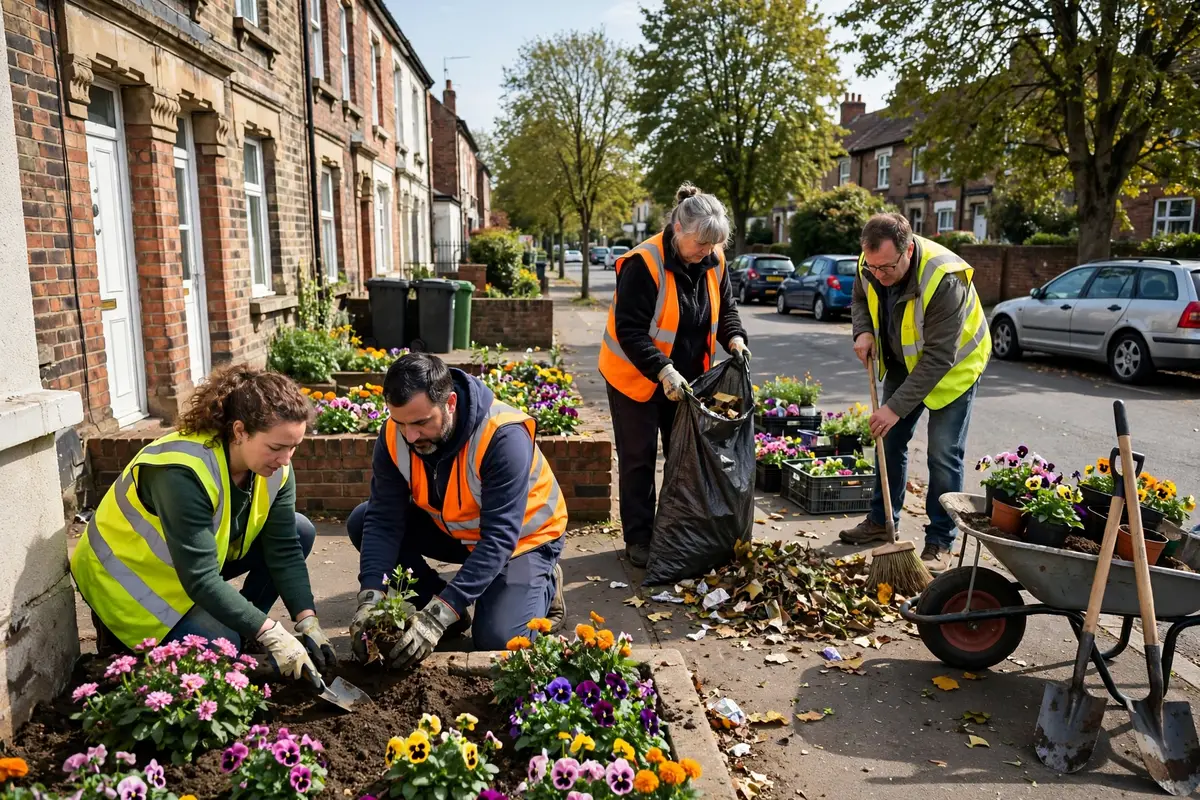
Action is where many community groups stall, and it is worth being concrete about what it looks like. For each priority, the group should leave the meeting with a short action list: what will be done, by whom, and by when. Actions might include a police operation or patrol pattern, a council inspection or repair, a letter or visit to a landowner, a community clean-up, better lighting, a speed survey, or a targeted information campaign to residents. Some actions are quick — a broken light reported and fixed. Others take months — a traffic-calming scheme working its way through council processes. Both count, as long as progress is reported honestly and delays are explained rather than hidden.
Reporting back is as important as acting. Residents who raise an issue and hear nothing will stop raising issues. A NAG that reports, even briefly — “the lighting on this path was fixed, the speed survey is scheduled, the fly-tipping reports are down this month” — builds the trust that keeps the whole model alive. Conversely, a group that meets in private and never tells the wider neighbourhood what it decided will be seen, fairly, as a clique rather than a community body. Short public notes after meetings, a noticeboard update, or a post through neighbourhood watch channels all help.
How A NAG Differs From Similar Groups
It is easy to confuse a NAG with its neighbours in the community landscape, so the distinctions are worth spelling out. A neighbourhood watch scheme is primarily about residents looking out for each other and sharing information about crime and suspicious activity, street by street. It is a valuable network, and watch coordinators are suggested NAG members, but a watch scheme does not set policing priorities or coordinate council action. A residents’ association is a broader body that represents residents’ interests on a range of issues — planning, amenities, social events — and may cover a housing estate or a village. It can be a powerful voice, but it is not coordinated by the police and its agenda is set by its members alone. A parish or town council is a formal tier of local government with its own powers and budget. A NAG overlaps with all three and replaces none of them; its distinctive job is to bring residents, police, council, and other organisations into one working group around a short, agreed list of priorities.
| Group | Main Job | Who Coordinates It | Key Difference From A NAG |
|---|---|---|---|
| Neighbourhood Action Group | Agree and act on 3 local priorities | Police, with community volunteers | Brings police, council, and residents into one working group |
| Neighbourhood Watch | Share crime information street by street | Resident coordinators | Information network, not a priority-setting body |
| Residents’ association | Represent residents on local issues | Residents | Broader agenda, not police-coordinated |
| Parish or town council | Formal local government duties | Elected councillors | A statutory body with its own powers and budget |
Outside the UK, similar ideas exist under different names. In the United States, for example, some counties run “neighborhood action teams” — multi-agency groups that bring government departments together to tackle complex community problems, listening to residents for solutions. The names and structures differ, but the underlying insight is the same: the problems that frustrate a neighbourhood rarely belong to one agency, so the response should not belong to one agency either.
What If Your Area Has No NAG?

If there is no active group, starting one is possible, but it works best when it grows from a real local concern rather than from the idea of having a group. Talk first to your local policing team and to a ward or parish councillor. They can tell you whether a group existed before and why it stopped, whether a neighbouring area has one you could join or learn from, and whether the timing is right. A group launched around a specific, widely felt issue — a road, a park, a recurring problem — will attract people faster than a group launched around the abstract idea of community engagement.
From there, the steps are practical. Gather a small founding circle of residents who reflect different parts of the neighbourhood, not just one street. Hold an initial open meeting with a clear purpose: to hear what issues people actually raise, not to adopt a ready-made agenda. Agree a simple way of working — how often you will meet, how notes will be shared, and how priorities will be reviewed. Invite the police, the council, and relevant local organisations from the start, because a group that begins as residents-only and tries to add agencies later often struggles to be taken seriously. And keep the first priority list short. Early, visible progress — a fixed light, a cleared fly-tip, a survey scheduled — does more for a new group’s credibility than a long list of ambitions.
Be realistic about what a volunteer group can and cannot do. A NAG cannot set police budgets, change planning law, or compel a council to spend money it does not have. What it can do is make sure the right people hear about a problem together, agree on what to do, and report back. That sounds small until you have watched a problem bounce between agencies for a year with nobody owning it. A group that ends that bouncing has done something real.
Common Pitfalls — And How To Avoid Them
The most common pitfall is becoming a talking shop: meetings where the same issues are discussed month after month with no actions and no owners. The antidote is the discipline described above — three priorities, named owners, reported progress — and a willingness to retire a priority that is not moving and replace it with one that can. The second pitfall is narrow membership: the same handful of voices, the same streets, the same age group. The antidote is active recruitment and a regular invitation to the wider neighbourhood to contribute, especially at the annual review. The third pitfall is overpromising. A group that promises to “solve crime” or “fix the estate” will disappoint; a group that promises to “get this path lit, this junction surveyed, and this fly-tipping hotspot cleared” can deliver, and delivery builds the mandate for the next round.
There is also a quieter risk: burnout. Volunteer groups run on goodwill, and goodwill is finite. Rotating small roles — chairing, note-taking, liaising with one agency — spreads the load and stops the group collapsing when one person steps back. Celebrating small wins helps too. A neighbourhood that sees a tangible improvement, however modest, is a neighbourhood more likely to turn up next time.
For more practical community guides in a similar plain style, you may enjoy the everyday explainers at ADailyInsight360, which cover community and lifestyle topics alongside news.
FAQs
What is a neighbourhood action group?
A Neighbourhood Action Group (NAG) is a UK volunteer working group, coordinated by the police, in which residents, councillors, businesses, neighbourhood watch coordinators, and local organisations agree on a neighbourhood’s top priorities and organise action on them.
Who can join a neighbourhood action group?
Any resident can get involved, and the suggested membership includes residents (including young people), parish and ward councillors, business representatives, neighbourhood watch coordinators, and the local policing team including PCSOs.
How many priorities does a NAG have?
Each NAG has three priority profiles — three priorities for the neighbourhood policing team to address with the help of NAG members. They are reviewed annually, with input invited from people outside the group.
Is a NAG the same as Neighbourhood Watch?
No. Neighbourhood Watch is a resident information network focused on crime awareness street by street. A NAG is a broader working group that sets priorities and coordinates action across police, council, and community organisations.
How do I find my local NAG?
Ask your local policing team or a ward or parish councillor, check neighbourhood policing pages for your area, or search for your town name together with “neighbourhood action group” to find meeting details or priority lists.
What kinds of issues do NAGs tackle?
It depends on the area: crime and anti-social behaviour, speeding, fly-tipping, street lighting, neglected green spaces, and other local concerns identified through public consultation.
Can I start a NAG if my area does not have one?
Yes, by talking first to your local policing team and councillors, gathering a small cross-section of residents, holding an open meeting around a real local issue, and inviting police, council, and local organisations from the start.
Read Also: 413 Area Code: Complete Western Massachusetts Guide
Related Stories

Chlor Calcium Explained: Uses, Safety and Practical Guide
Chlor calcium usually means calcium chloride, a versatile compound used for de-icing, drying, dust control, and more. Here…

Rivet: Types, Uses, and How to Choose the Right One
From solid rivets in aircraft and bridges to pop rivets in DIY projects, here is how rivets work,…

Moldavite Crystal Meaning and Real vs Fake Guide
What moldavite is, where it comes from, what collectors mean by its energy, and the practical checks that…
1 response