Transfer Case Transfer Case: Your 4WD Guide (2026)
A transfer case is the gearbox in a four-wheel-drive vehicle that splits engine power between the front and rear axles. This guide explains how it works, when to use each mode, and what to do when it goes wrong.

Transfer Case Transfer Case: Your 4WD Guide (2026)
The short version: a transfer case is the gearbox in a four-wheel-drive vehicle that takes power from the transmission and splits it between the front and rear axles, so all four wheels can drive. It is also what gives many 4WD vehicles their low-range gearing for slow, steep, or slippery work. If you have ever wondered what actually happens when you turn a dial from 2H to 4H to 4L, the answer lives in this one component.
A quick note on the doubled phrase in the title: people searching for this topic often type the term twice, or search engines repeat it in suggestions, which is why you may see “transfer case transfer case” as a search phrase. There is no separate part called a “transfer case transfer case.” The component itself is simply the transfer case, and this guide covers that component in full — what it does, how its modes work, the main types, the warning signs of trouble, and how to look after it.
What Is A Transfer Case?
In a conventional two-wheel-drive car, the path of power is simple: engine to transmission to one driven axle — usually the front axle in a front-wheel-drive car, or the rear axle in a rear-wheel-drive car — and then to the wheels. A four-wheel-drive vehicle needs something extra, because it has to feed two driven axles from one transmission output. The transfer case is that something extra. It is an intermediate gearbox, mounted behind the transmission in a traditional 4WD layout, that receives the transmission’s output and divides it between two driveshafts: one running to the front axle, one to the rear axle.
The simplified power path looks like this: engine, then transmission, then transfer case, then driveshafts, then differentials, then wheels. Each step has a job. The engine makes the power. The transmission changes gear ratios so the vehicle can move at different speeds. The transfer case distributes that power to both ends of the vehicle. The differentials then allow the wheels on each axle to turn at slightly different speeds when cornering, which they must, because the outside wheel travels further around a bend than the inside wheel.
It is important not to confuse the transfer case with the transmission. The transmission’s job is to change ratios — first gear for pulling away, higher gears for cruising. The transfer case’s job is distribution and, in many designs, an extra layer of gear reduction. They sit next to each other and work together, but they are different components with different fluids, different failure modes, and different service needs. When a garage talks about “transfer case service,” it means servicing this distribution gearbox, not the main transmission.
Step 1: Understand What It Does — Three Jobs In One Box
Most transfer cases do up to three things, depending on the design. The first is splitting power. In a part-time 4WD system, the driver chooses when the front axle is engaged; in a full-time or automatic system, the split happens continuously or as conditions demand. Either way, the transfer case is the component that makes two-axle drive possible. Without it, a vehicle built on a traditional layout would only ever drive its rear wheels.
The second job is providing drive modes. The familiar selector positions — 2H, 4H, 4L, and sometimes 4A or Auto — are transfer case modes. They change how power is distributed and, in low range, how much it is geared down. Learning what each mode means is the single most useful thing a 4WD owner can do, because using the wrong mode is the fastest way to strain the drivetrain or lose traction when you need it most.
The third job, on many systems, is gear reduction. Low range is a separate set of gears inside the transfer case that multiplies torque — the turning force at the wheels — while reducing speed. A commonly cited low-range reduction is around 2.7:1, though the exact ratio varies by vehicle. In practical terms, low range lets a vehicle crawl slowly and deliberately up a steep slope, through deep mud, or over large obstacles, with far more pulling force than high range could provide, and without riding the clutch or overheating an automatic transmission. It is the difference between forcing a vehicle through terrain and letting the gearing do the work.
Some transfer cases also handle a fourth, subtler job: managing the speed difference between the front and rear axles. On high-speed four-wheel-drive and all-wheel-drive systems, the front and rear wheels do not always rotate at exactly the same speed, especially when cornering or when tyres differ slightly in size. Certain transfer case designs use a centre differential or a clutch pack to allow for that difference, so the drivetrain is not wound up and stressed. On part-time systems without such a mechanism, that is precisely why driving in 4WD on dry, grippy tarmac is discouraged — the axles cannot slip relative to each other, and something has to give.
Step 2: Learn The Modes — 2H, 4H, 4L, And Auto

If your vehicle has a 4WD selector, you will recognise most of these positions, though the exact labels vary by make. The table below summarises the common ones, and the text that follows explains when each one earns its keep.
Table:
| Mode | What It Does | When To Use It |
|---|---|---|
| 2H (two-wheel-drive, high) | Drives one axle only, usually the rear | Normal roads, dry tarmac, everyday driving |
| 4H (four-wheel-drive, high) | Drives both axles at normal gearing | Snow, gravel, wet grass, light off-road |
| 4L (four-wheel-drive, low) | Drives both axles with gear reduction | Steep slopes, deep mud, rock crawling, heavy towing at low speed |
| 4A / Auto | Engages the front axle automatically when slip is detected | Mixed conditions, changeable surfaces |
In 2H, the vehicle behaves like a two-wheel-drive vehicle. This is the mode for normal roads, and it is also the most fuel-efficient, because the drivetrain is not dragging a second driven axle along. Most part-time 4WD owners spend most of their time here, and that is exactly right.
In 4H, both axles are driven at the normal (roughly 1:1) transfer case ratio. This is the mode for loose or slippery surfaces where extra traction helps but speed is still normal: snow-covered roads, gravel tracks, wet fields, sandy lanes. It is not a magic grip button, and it does not shorten braking distances — a common and dangerous misunderstanding. Four-wheel drive helps you get moving and stay moving; it does not help you stop. Tyres and speed matter far more for braking than the drive mode.
In 4L, both axles are driven through the reduction gears. Speeds are low — walking pace to a brisk jog, typically — and torque is high. This is the mode for the hardest work: climbing a steep, loose slope, descending one in a controlled crawl, pulling a heavy trailer out of soft ground, or picking through rocks. Use it only at low speed, and come out of it as soon as the hard section is done. Driving in low range on a normal road is noisy, inefficient, and hard on the drivetrain.
In 4A or Auto, found on many modern trucks and SUVs, the system watches for wheel slip and engages the front axle when it is needed, then disengages it when it is not. This is a good compromise for changeable conditions — a road that alternates between clear and snow-covered, for example — because it saves the driver from constantly switching modes. It is not the same as a full-time 4WD system with a centre differential, and the distinction matters for how the vehicle should be driven, but for most owners the practical advice is simple: Auto for mixed conditions, 4H for consistently loose surfaces, 4L for the hardest sections, 2H for everything else.
Step 3: Know The Main Types
Not all transfer cases work the same way, and the differences explain why two 4WD vehicles can feel so different. The broad families are worth knowing, even if you never open one up.
Part-time transfer cases are the traditional type: the driver selects 2WD or 4WD manually, usually with a lever or a dial. In 4WD, the front and rear outputs are locked together, so the axles turn at the same speed. That is strong and simple, and it is why part-time systems should not be used on dry tarmac — with no slip allowed between the axles, cornering on a grippy surface winds the drivetrain up and can damage tyres, driveshafts, or the transfer case itself. Many pickups and older SUVs use this type.
Full-time transfer cases include a centre differential, which allows the front and rear axles to turn at different speeds, so the vehicle can stay in four-wheel drive permanently, including on tarmac. Some full-time systems let the driver lock that centre differential for off-road work, which returns the system to a locked, part-time-like behaviour when maximum traction is needed. This type is common on larger SUVs designed to be capable both on and off the road.
Automatic or on-demand systems use electronically controlled clutches to send power to the second axle when slip is detected. They are sometimes described as transfer cases and sometimes as power transfer units, depending on the layout — particularly on transverse-engined vehicles, where the packaging is different from a traditional longitudinal truck layout. The principle is the same, though: power is distributed to both axles when it is needed, and the driver may have little or nothing to select. These systems prioritise convenience and on-road behaviour over the brute capability of a locked, low-range transfer case, which is a fair trade for most drivers who rarely leave tarmac.
Inside the box, the mechanism also varies. Some transfer cases use gears to connect the outputs, others use a chain drive, and many modern ones use clutch packs, sometimes in combination. Gear-driven cases are known for strength and durability; chain-driven cases are quieter and lighter; clutch-based systems allow the variable, automatic distribution described above. None of these is universally “best” — the right choice depends on whether the vehicle is built for heavy off-road work, for comfortable all-weather road use, or for something in between.
Step 4: Spot Trouble Early

Transfer cases are sturdy, but they are not maintenance-free, and their problems tend to announce themselves if you know what to listen and feel for. The most common warning signs are worth learning, because catching them early is almost always cheaper than waiting.
Fluid leaks are the first thing to check. The transfer case is filled with a specific fluid that lubricates its gears, chains, and bearings, and that fluid degrades under heat and shear forces over time. A leak — visible as oil staining under the middle of the vehicle, around the transfer case housing — means the fluid level is dropping, and running low on fluid accelerates wear rapidly. Any unexplained oil patch under the centre of a 4WD vehicle deserves a look, and it should not be assumed to be engine oil or transmission fluid until someone has actually checked.
Noise is the second signal. Grinding, whining, or clunking from underneath the vehicle, especially noises that change with drive mode or appear only in 4WD, often point to the transfer case. A chain that has stretched, bearings that are worn, or gears that are damaged all make distinctive sounds, and a driver who knows their vehicle’s normal sounds will notice the change before it becomes a failure. Similarly, difficulty shifting between modes — a selector that sticks, grinds, or refuses to engage — is a transfer case symptom, not a quirk to live with. On electronically controlled systems, a warning light or a 4WD system message on the dashboard is the equivalent signal: the system has detected a fault, and it should be diagnosed rather than cleared and ignored.
Vibration and binding are the third group. A vibration that appears at certain speeds, or a feeling of the vehicle fighting itself when turning in 4WD on a firm surface, can indicate a transfer case problem — or, on a part-time system, simply that 4WD is engaged where it should not be. The distinction matters: binding on dry tarmac in 4H on a part-time system is expected behaviour, and the remedy is to switch back to 2H. Binding that persists in 2H, or on a full-time system that should allow axle speed differences, is a fault. When in doubt, switch to 2WD if the system allows it, note exactly when the symptom appears, and describe that pattern to a mechanic. “It grinds when I select 4L” is far more useful than “it makes a noise sometimes.”
Step 5: Look After It
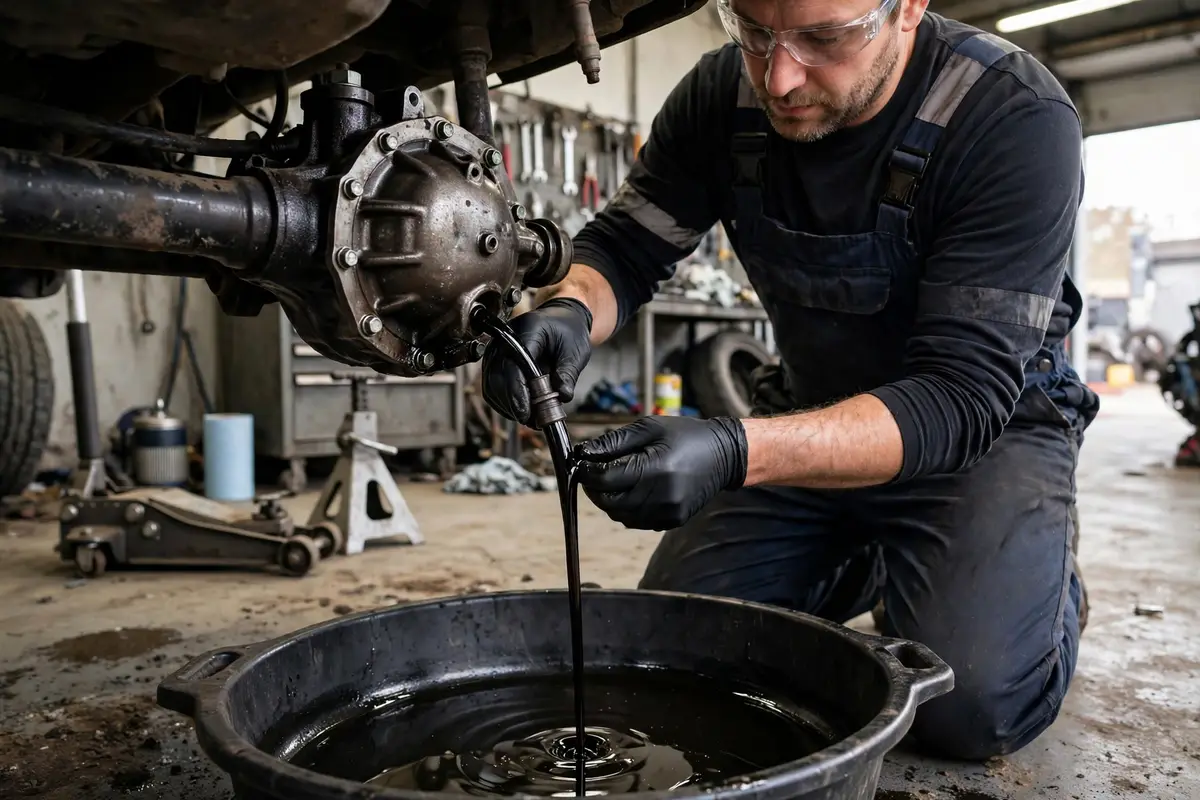
Transfer case maintenance is, for most owners, refreshingly simple: use the right fluid, change it when the manufacturer says to, and do not ignore leaks or noises. The details, though, are where people go wrong, so they are worth spelling out.
First, use the fluid the manufacturer specifies for your vehicle. Transfer case fluids are not interchangeable in the way engine oils sometimes are. Some transfer cases use automatic transmission fluid, some use a dedicated transfer case fluid, and some use gear oil, and using the wrong one can damage clutches or seals. The owner’s manual or a reputable parts catalogue for your exact model will give the specification. If a garage suggests a “universal” fluid, ask them to confirm it matches the manufacturer’s specification for your vehicle before agreeing.
Second, respect the service interval, and adjust it for how you actually use the vehicle. A 4WD vehicle that spends its life on tarmac and rarely engages four-wheel drive will be easier on its transfer case fluid than one that tows heavy trailers, wades through water, or works off-road regularly. Towing, off-roading, and water crossings all justify shorter intervals, and many manufacturers publish a “severe use” schedule alongside the normal one. If you have crossed water deep enough to reach the transfer case, have the fluid checked promptly: water contamination is one of the fastest ways to damage the internals, and it does not always announce itself immediately.
Third, use the system. A part-time 4WD system that is never engaged for months can develop stiff linkages or seals that dry out, and an owner who has never practised selecting 4L will fumble it when they actually need it. A short, gentle engagement of 4WD on a loose surface every month or so — a gravel car park, a grassy field, not dry tarmac — keeps the mechanism exercised and keeps the driver familiar with it. Think of it as a fire drill for your drivetrain: boring when nothing is wrong, invaluable when something is.
Finally, get problems diagnosed by someone who knows 4WD systems. Transfer case work sits between transmission work and general mechanics, and a garage that rarely sees 4WD vehicles may misdiagnose a transfer case fault as a transmission or differential fault, or vice versa. A specialist, or a main dealer for your make, will have seen your system’s common failures before and will know whether a repair, a rebuild, or a replacement unit makes sense. Ask for the diagnosis in plain terms — what failed, why, and what the options cost — before authorising work. A transfer case replacement is a significant job, and you deserve to understand it before you pay for it.
Transfer Case Versus Similar Parts
A few confusions come up repeatedly, and clearing them up saves misdiagnosis. The transfer case is not the transmission: the transmission changes gear ratios for speed, while the transfer case distributes power to the axles. It is not a differential: differentials sit at each axle and allow the left and right wheels to turn at different speeds, while the transfer case works between the axles. It is not the same as a power take-off, which is a separate device on some commercial vehicles for driving external equipment. And on many modern crossovers, the component that distributes power may be called a power transfer unit rather than a transfer case, because of how the engine is mounted — but the job it does is closely related, and the maintenance principle (right fluid, right interval, no ignored leaks) is the same.
Understanding those distinctions helps when you talk to a mechanic, when you read a service estimate, and when you shop for a used 4WD vehicle. On a used vehicle, a transfer case that shifts smoothly through all modes, shows no leaks, and has a service history is a genuine selling point. One that grinds, sticks, or leaks is a negotiation point — or a reason to walk away, depending on the cost of the fix.
For more practical everyday guides in a similar plain style, you may enjoy the range at 9bio, which covers useful topics from cars to home life in straightforward language.
FAQs
What does a transfer case do?
A transfer case is a gearbox in a four-wheel-drive vehicle that takes power from the transmission and splits it between the front and rear axles, so all four wheels can drive. Many also provide low-range gearing for slow, difficult terrain.
Is a transfer case the same as a transmission?
No. The transmission changes gear ratios for different speeds. The transfer case distributes the transmission’s output to the front and rear axles and, on many systems, adds low-range gearing.
What is the difference between 2H, 4H, and 4L?
2H drives one axle for normal roads. 4H drives both axles at normal gearing for snow, gravel, and light off-road use. 4L drives both axles through reduction gears for steep, muddy, or rocky terrain at low speed.
Can I drive in 4WD on dry tarmac?
On a part-time system without a centre differential, no — it can wind up the drivetrain and cause damage. Full-time systems with a centre differential can be used on tarmac. When in doubt, use 2H on dry roads.
What are the signs of a bad transfer case?
Fluid leaks under the middle of the vehicle, grinding or whining noises (especially in 4WD), difficulty shifting modes, dashboard 4WD warnings, and vibration or binding are the common warning signs.
How often should transfer case fluid be changed?
Follow your vehicle’s manufacturer interval, and shorten it if you tow, off-road, or cross water regularly. Always use the fluid specification listed for your exact model.
What is “transfer case transfer case” as a search phrase?
It is a doubled version of the term “transfer case,” likely from repeated typing or search suggestions. There is no separate component by that doubled name — the part itself is the transfer case.
Read Also: Neighbourhood Action Group Explained For Residents
Related Stories

2025 Lincoln Corsair Complete SUV Review (2026 Guide)
The 2025 Lincoln Corsair is a compact luxury SUV that pairs a quiet, comfortable cabin with a choice…

Bombardier Global 7500 Business Jet (2026 Guide)
The Bombardier Global 7500 is a long-range business jet built for nonstop intercontinental travel, with a four-zone cabin…
How to Lease a Toyota Tacoma (2026): Complete Guide to Deals, Costs & Terms
Leasing a Toyota Tacoma can cost less per month than you expect — but only if you understand…
1 response