Men’s Style in the 50s: Classic Looks That Still Work
The 1950s gave menswear some of its most lasting looks, from the sharp grey suit to the leather jacket and the Ivy League blazer. Here is what defined the decade and how to wear it well today.
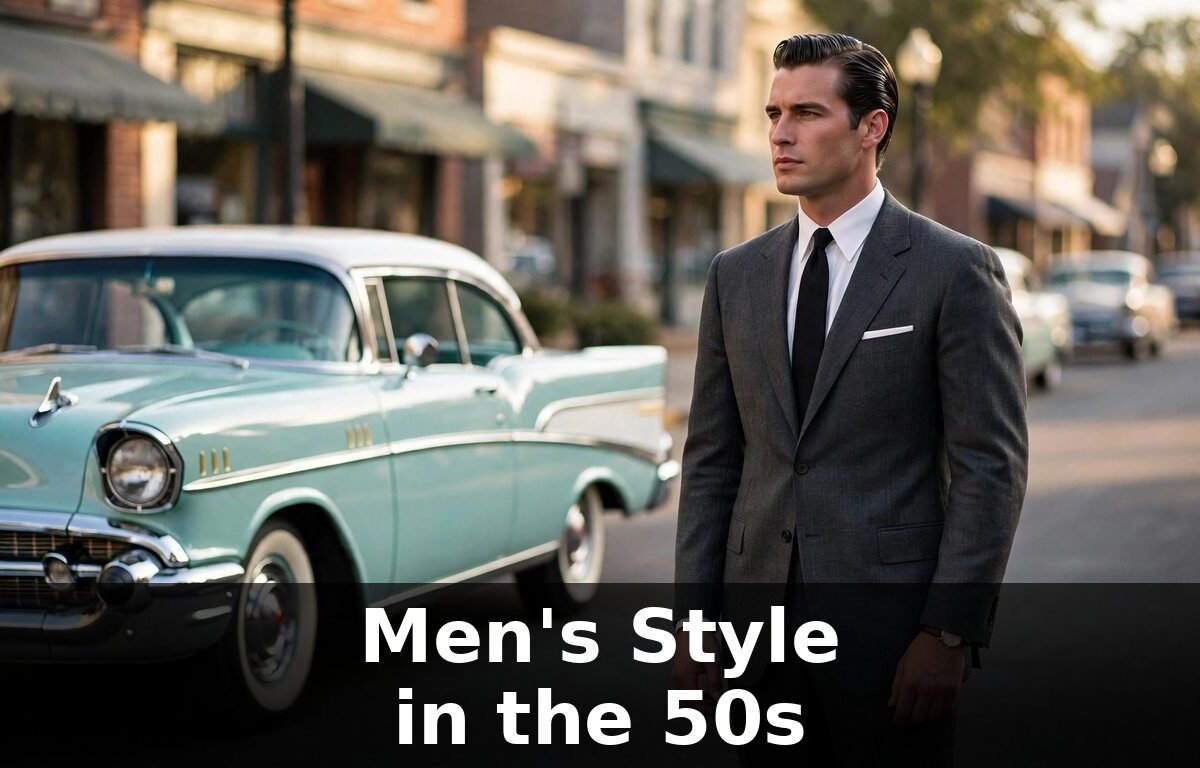
Picture a man walking down a street in 1955. He might be wearing a neat grey suit with a narrow tie, or a white T-shirt with the sleeves rolled up and a leather jacket slung over his shoulder, or a tweed jacket with a button-down shirt and chinos. All three of those men would have looked completely normal, and all three would still look good today. That is the strange staying power of men’s style in the 50s. The decade did not produce one look. It produced several, and most of them never really went away.
The 1950s sat between two very different worlds. The war years had been about rationing, uniforms and making do. By the early fifties, factories were busy again, wages were rising, and ordinary men could afford a proper suit, a decent pair of shoes and a haircut every couple of weeks. At the same time, a new generation of teenagers and young men started dressing for themselves rather than copying their fathers. The result was a decade of contrasts: polished business tailoring on one side, rebellious rock-and-roll style on the other, and a smart-casual middle ground that still shapes how men dress for the office, the weekend and a night out.
This article breaks down what men’s fashion actually looked like in the 1950s, who wore it best, and how to borrow the best of it without looking like you are wearing a costume. Every claim here sticks to the well-documented facts of the decade. Where details are a matter of taste rather than history, that is made clear.
The short version: 1950s men’s style rested on three pillars. First, the tailored suit, worn narrower and cleaner than the broad-shouldered suits of the 1940s. Second, the greaser look: jeans, boots, a white T-shirt and a leather jacket. Third, the Ivy League look: button-down shirts, chinos, loafers and unstructured blazers. Add neat hair, polished shoes and simple grooming, and you have the decade in a nutshell. The modern trick is to take one element at a time rather than wearing all of them at once.
What Actually Defined Men’s Style in the 50s
To understand the decade, it helps to know what came before it. In the 1940s, men’s suits had wide shoulders, wide lapels and a boxy, military-influenced shape. Fabric was rationed in Britain and in short supply in much of Europe, so clothes were cut with economy in mind. When the fifties arrived, the shape softened and slimmed down. Shoulders became more natural, jackets grew a little shorter, trousers lost some of their width, and the overall line of a suit became cleaner and closer to the body.
At the same time, casual clothing became a real category for the first time. Before the war, most men owned a suit and a few shirts, and “casual” mostly meant taking the jacket off. In the fifties, men started buying clothes made purely for leisure: polo shirts, Hawaiian shirts, chinos, loafers and lightweight jackets. The idea of a weekend wardrobe took hold, and it never left.
Colour played a part too. The early fifties favoured sober colours for business: charcoal, navy, mid-grey and brown. But casual wear opened the door to brighter shades, bold patterns and prints that would have looked out of place in an office. Pastel shirts, checked sports jackets, patterned ties and suede shoes all became common sights on the street.
Three forces shaped the decade’s style more than anything else. The first was prosperity: more men had money to spend on clothes, and ready-to-wear tailoring improved enough that a shop-bought suit could look genuinely good. The second was Hollywood: film stars set the standard for what a well-dressed man looked like, and their outfits were copied within weeks. The third was youth culture. Rock and roll, the motorcycle, the jukebox and the drive-in gave young men a reason to dress differently from their parents, and the fashion industry noticed.
The Three Looks That Ruled the Decade
Almost everything in 1950s menswear falls into one of three camps. Most men mixed them depending on the occasion. A man might wear a suit to work, chinos and a polo shirt on Saturday, and jeans and a leather jacket on Saturday night. Knowing the three looks is the fastest way to understand the decade.
The Sharp Suit
The 1950s suit is the backbone of the decade. It was single-breasted more often than double-breasted, with two or three buttons, a natural shoulder and a slim lapel. The jacket was cut close to the body without being tight, and trousers were flat-fronted with a fairly straight leg. The whole effect was neat, understated and quietly confident.
The standard business outfit was a charcoal or navy suit, a white or pale blue shirt, a tie in a solid colour or a small neat pattern, black leather shoes and a matching belt. Socks were dark and plain. The shirt collar was a classic point collar, worn with the top button done up and the tie knotted neatly. Pocket squares were common, usually white linen folded flat, though bolder men wore a coloured silk one.
For evening or formal occasions, the dinner suit, what Americans call a tuxedo, was the standard. Black tie dress in the fifties was simpler than it had been before the war, with a single-breasted jacket, a white shirt with a turndown collar and a black bow tie. The look was deliberately restrained, which is exactly why it still works today.
What made the fifties suit different from a modern one was mostly the details: slightly shorter jacket length, narrower lapels, a higher trouser rise and a slimmer tie. The tie is the easiest tell. Ties in the fifties were noticeably narrower than the wide ties of the seventies, usually around two to three inches at the widest point, and they were often worn a little shorter.
The Greaser Look
The greaser look was the decade’s rebellion, and it came from working-class youth culture, motorcycle clubs and rock and roll. It was built on a handful of cheap, tough pieces worn with attitude: a plain white T-shirt, blue jeans, boots or engineer boots, and a leather jacket. The hair was the finishing touch, slicked back with pomade into a quiff or a ducktail.
James Dean made the look famous on screen, and Marlon Brando gave it a harder edge. But the greaser style was already on the streets before Hollywood picked it up. Young men who rode motorcycles needed tough clothing, and denim and leather were the practical choice. The style then spread to teenagers who had never sat on a motorcycle in their lives, because it looked cool and because it annoyed their parents, which was half the point.
The details mattered. The T-shirt was plain white cotton, with the sleeves often rolled up to show the upper arm. The jeans were straight-legged and dark, worn with a leather belt and heavy boots. The leather jacket was usually a black motorcycle jacket with a diagonal zip and a snap-down collar, or a simpler straight-zip style. Sunglasses, a comb in the back pocket and a pack of cigarettes rolled into a sleeve completed the picture, though the last two are best left in the past.
What is easy to miss is that the greaser look was not sloppy. The clothes were simple, but they were worn with care. The T-shirt was clean and white, the jeans were pressed, the boots were polished and the hair was combed precisely. The look was casual, not careless, and that is why it still photographs so well.
The Ivy League Look
The third look came from the campuses of the American north-east, and it was the opposite of the greaser style in almost every way. Where the greaser look was tough and rebellious, the Ivy League look was relaxed, neat and quietly privileged. It was the style of university students and young professionals, and it became the template for smart-casual dressing that the whole English-speaking world still follows.
The Ivy League wardrobe was built on soft, comfortable pieces. The button-down Oxford shirt was the foundation, worn with chinos, a crew-neck sweater or a tweed sports jacket, and loafers or saddle shoes. The jacket was unstructured, meaning it had little or no padding in the shoulders, so it hung naturally and looked relaxed rather than formal. Sack suits, cut straight through the body with no waist suppression, were the Ivy League suit of choice.
Accessories were understated: a knitted tie or a rep stripe tie, a simple leather belt, argyle socks and a plain watch. The overall impression was of a man who was well dressed without trying too hard. The clothes were often slightly worn in, which was part of the charm. A tweed jacket that had softened with age or a pair of loafers that had moulded to the foot were signs of a wardrobe that was lived in rather than bought for show.
The Ivy League look spread far beyond American campuses. By the late fifties it was the default smart-casual style in Britain too, where it mixed with local traditions of tailoring and knitwear. The modern preppy look, the smart-casual office outfit and even the classic American style of brands that still trade on it today all trace back to this decade.
The Icons Who Set the Standard
Fashion in the fifties was driven by faces as much as by designers. A handful of film stars defined what men wanted to look like, and each of them stood for a different version of the decade.
Cary Grant: The Polished Gentleman
Cary Grant was the decade’s standard for elegance. His style was built on perfectly fitted suits, crisp shirts and an ease that made formal dressing look effortless. He favoured grey and navy suits, often with a subtle pattern, white shirts and simple ties. His hair was always neat, his shoes always polished, and nothing he wore ever looked fussy or overdone. Grant’s lesson is that fit matters more than fashion. A well-cut suit in a plain colour, worn with confidence, beats a trendy outfit every time.
James Dean: The Rebel
James Dean only made three films before his death in 1955, but his image has lasted longer than almost any other actor’s. His most famous look, the red jacket, white T-shirt and jeans from Rebel Without a Cause, became one of the most copied outfits in history. Dean’s style worked because it was simple and because he wore it with complete conviction. He showed that a man could look striking in the plainest clothes, as long as they fit well and were worn with intent.
Marlon Brando: The Tough Guy
Marlon Brando brought a raw, physical quality to fifties style. In The Wild One, released in 1953, he wore a black leather motorcycle jacket, jeans and boots, and the outfit became the uniform of the greaser movement. In A Streetcar Named Desire, his tight white T-shirt made a humble undershirt into a fashion statement. Brando’s looks were about the body as much as the clothes, and his influence pushed menswear towards a more casual, more physical style than the decade had known before.
Elvis Presley: The Showman
Elvis Presley took fifties style in a flashier direction. His stage outfits were bold, with bright colours, patterned shirts and sharp jackets, and his everyday style mixed western details with rock-and-roll attitude. Elvis popularised the pompadour hairstyle, the turned-up collar and the idea that a man’s clothes could be a performance in themselves. His influence was strongest among teenagers, and it helped make fashion something young men cared about in their own right rather than something they inherited from their fathers.
Frank Sinatra and the Rat Pack
Frank Sinatra and his circle represented the decade’s smarter, nightclub side. Sinatra favoured sharp suits, often with a hat, a crisp white shirt and a tie knotted with precision. His style was formal but relaxed, the look of a man who was comfortable in a suit because he wore one every day. The fedora, which had been standard menswear for decades, began to fade during the fifties as younger men stopped wearing hats, but Sinatra kept wearing his, and for evening dressing the hat remained the finishing touch.
Everyday Workwear and Casual Style
Not every man in the fifties dressed like a film star. Most men dressed for work, and workwear had its own honest style. Factory workers, mechanics and tradesmen wore sturdy cotton shirts, denim or twill trousers, work boots and jackets built to last. The denim jacket, the chore coat and the field jacket all came from this world, and they have since become fashion staples in their own right.
For office workers, the working week meant a suit, but the weekend meant something else. Saturday was for chinos, a polo shirt or a short-sleeved checked shirt, and comfortable shoes. The polo shirt, which had come from tennis and golf, became a casual staple during the decade. The Hawaiian shirt, brought home by servicemen who had been stationed in the Pacific, became a popular holiday and summer shirt, worn untucked with shorts or light trousers.
Sportswear also entered everyday life in the fifties. Sweatshirts, track jackets and canvas sneakers, once confined to the gym or the running track, started appearing on the street. This was the beginning of the long shift towards casual dressing that would dominate the rest of the century. The fifties did not invent casual style, but they made it respectable.
Shoes deserve a mention of their own. The decade’s footwear ranged from polished Oxford shoes for the office to loafers, saddle shoes and suede desert boots for casual wear. White bucks, light suede shoes worn in summer, were a particular favourite of the Ivy League set. For the greaser look, the engineer boot was the shoe of choice, heavy, black and built for riding. Whatever the style, shoes in the fifties were kept clean and polished. Scuffed shoes were a sign of a man who did not care about his appearance, and in a decade that cared a great deal, that mattered.
Fabrics, Colours and Patterns
The fabrics of the fifties were mostly natural: wool, cotton, linen and leather. Synthetic fabrics were beginning to appear, but wool was still the standard for suits and cotton the standard for shirts. Tweed, flannel and gabardine were the workhorse suit fabrics, each with its own character. Tweed was textured and rustic, flannel was soft and warm, and gabardine was smooth and hard-wearing.
Patterns were used with restraint in formal wear and with more freedom in casual wear. The classic suit patterns were pinstripes, chalk stripes, subtle checks and herringbone. Ties carried small geometric patterns, dots and stripes. Casual shirts opened up to larger checks, plaids, stripes and novelty prints. The Hawaiian shirt was the most extreme example, but checked sports shirts and patterned knitwear were everyday sights.
Colour followed a clear split. Business dress stayed sober: navy, charcoal, grey and brown, with white or pale blue shirts. Casual dress was where colour lived. Pastel shades such as pale pink, powder blue and mint green appeared on shirts and knitwear. Bold colours showed up on sports jackets, ties and socks. The contrast between the sober suit and the colourful weekend wardrobe is one of the decade’s most recognisable features, and it is still a useful rule today: keep the suit simple, and let the casual pieces carry the colour.
Grooming: Hair, Shaving and Scent
No account of 1950s men’s style is complete without grooming, because the hair was as much a part of the look as the clothes. The two dominant hairstyles were the neat side part and the slicked-back quiff. The side part was the establishment style, short at the back and sides, longer on top, combed neatly to one side. The quiff was the young man’s style, with the front swept up and back with pomade. The pompadour, associated with Elvis, was the tallest and boldest version, with the hair swept high at the front.
Pomade was the styling product of the decade. It gave hair hold and shine, and it allowed the elaborate combing that defined fifties hairstyles. Hair was cut regularly, usually every two weeks, and a visit to the barber was a routine part of a man’s week rather than an occasional chore.
Shaving was a daily ritual. Most men shaved with a safety razor and a brush, and aftershave was part of the routine. The clean-shaven face was the standard for the decade. Moustaches were worn by some older men, but beards were rare. The clean-shaven look matched the neat, polished character of fifties style, and it is one of the reasons the decade photographs so crisply.
Cologne was simpler than it is today. A man might wear a single aftershave or eau de toilette, applied sparingly. The scents of the era tended towards citrus, lavender, wood and spice, fresh and clean rather than heavy. Grooming in the fifties was about looking tidy and smelling clean, not about making a statement.
How to Wear 1950s Style Today
The best way to wear fifties style now is to borrow, not to copy. A full head-to-toe fifties outfit belongs at a themed party. One or two period pieces, mixed with modern clothes, look stylish in everyday life. The steps below show how to do it.
Step 1: Start With the Fit, Not the Era
The single most important lesson of the fifties is fit. The decade’s best-dressed men wore clothes that fit their bodies properly. Shoulders sat where shoulders should sit, jacket sleeves showed a little shirt cuff, trousers broke gently over the shoe, and nothing pulled or bagged.
Before buying anything vintage-inspired, get the fit right on the clothes you already own. A modern suit that has been tailored to fit will look closer to a fifties ideal than an ill-fitting vintage suit ever will. Pay attention to the shoulders first, then the jacket length, then the trouser length. If you only change one thing about how you dress, make it the fit.
Step 2: Pick One Look and Build Around It
Choose one of the three fifties looks and make it your starting point. If you work in an office, start with the sharp suit: a navy or charcoal suit, a white shirt, a slim tie and polished black shoes. If your life is more casual, start with the Ivy League look: chinos, a button-down Oxford shirt, a crew-neck sweater and loafers. If you want something with more edge, start with the greaser look: dark straight-leg jeans, a plain white T-shirt, boots and a leather jacket.
Once you have the foundation, add one period detail at a time. A knitted tie, a pair of suede shoes, a tweed jacket or a neatly combed side part can each bring a touch of the fifties without turning the outfit into a costume. The mistake to avoid is wearing every element at once. A leather jacket, a quiff, engineer boots and a white T-shirt together say fancy dress. A leather jacket with dark jeans and a plain modern shirt says style.
Step 3: Choose Colours and Fabrics That Flatter You
Fifties colours work well on most men because they are mostly muted and natural. Navy, charcoal, grey, brown, cream and olive are easy to wear and easy to combine. Use them as the base of your wardrobe, and add colour through shirts, ties, knitwear and accessories rather than through loud jackets or trousers.
Fabrics matter as much as colours. Wool, cotton, linen and leather age well and look better with wear than synthetic fabrics do. A wool blazer, a cotton Oxford shirt and a pair of leather shoes will look good for years if they are cared for. When you buy, feel the fabric and check the construction. A well-made garment in a natural fabric is a better investment than three cheap ones.
Step 4: Get the Details Right
Details are what separate a good outfit from a great one, and the fifties were a decade of details. Keep your shoes polished. Wear a belt that matches your shoes. Make sure your shirt collar sits neatly under your jacket. Fold a white pocket square into your jacket pocket for a smarter occasion. Keep your watch simple and your jewellery minimal.
Hair deserves the same attention. You do not need a full pompadour, but a neat cut with a side part or a tidy swept-back style will do more for a fifties-inspired look than any item of clothing. Use a small amount of pomade or a modern styling product with a natural finish, and keep the sides neat. A regular haircut, every three to four weeks, keeps the shape right.
Step 5: Know When to Stop
The final step is restraint. The fifties look works because it is simple, so resist the urge to add more. One statement piece per outfit is enough. If you are wearing a leather jacket, keep the rest of the outfit plain. If you are wearing a patterned sports jacket, keep the shirt and trousers simple. If you are wearing a bold tie, keep the suit sober.
It also helps to think about context. A full suit is right for a wedding, a job interview or a formal dinner. Chinos and a blazer are right for a smart lunch or a day at the office. Jeans and a leather jacket are right for an evening out. Matching the level of dress to the occasion is itself a fifties value, and it is one that never goes out of style.
1950s Men’s Style at a Glance
| Look | Key pieces | Best for | Modern tip |
|---|---|---|---|
| The sharp suit | Single-breasted suit, white shirt, slim tie, Oxford shoes | Work, weddings, formal events | Choose navy or charcoal; get the fit tailored |
| The greaser | White T-shirt, dark jeans, leather jacket, boots | Evenings, weekends, casual nights out | Wear one statement piece, not the full costume |
| Ivy League | Oxford shirt, chinos, unstructured blazer, loafers | Smart-casual days, office, lunch | Keep colours muted and the fit relaxed |
| Workwear | Denim jacket, chore coat, sturdy boots | Casual weekends, outdoor days | Mix with modern basics to keep it current |
| Evening | Dinner suit, bow tie, polished black shoes | Black tie events, formal dinners | Keep it simple; the classic needs no updating |
Common Mistakes to Avoid
The most common mistake is going too far. A fifties-inspired outfit should look like good taste, not like a period drama. Avoid wearing a hat, a wide tie, a waistcoat, a pocket watch and a pair of spats all at once. Each of those pieces can work on its own, but together they overwhelm the outfit and the man wearing it.
The second mistake is choosing the wrong fit. Fifties clothes were slimmer than forties clothes, but they were not skin-tight. A suit that is too tight looks uncomfortable and modern in the wrong way. Aim for a fit that follows the body without pulling at the buttons or creasing across the chest.
The third mistake is neglecting grooming. The fifties look depends on neat hair, clean shoes and a tidy appearance. An otherwise perfect outfit loses its effect when the shoes are scuffed or the hair is unkempt. Spend a few minutes on the details and the whole outfit improves.
The fourth mistake is buying cheap imitations. A plastic-looking leather jacket or a shiny polyester suit will not capture the decade, because the fifties look was built on natural fabrics and honest construction. Buy fewer pieces and buy better ones. A single good leather jacket or a single well-cut suit will serve you far longer than a wardrobe of imitations.
FAQs
What is 1950s men’s fashion known for?
1950s men’s fashion is known for three main looks: the sharp tailored suit, the greaser style of jeans, T-shirts and leather jackets, and the relaxed Ivy League look of button-down shirts, chinos and loafers. The decade combined post-war polish with a new youth culture, and neat grooming tied the looks together.
Who were the biggest men’s style icons of the 1950s?
Cary Grant set the standard for elegant tailoring, James Dean and Marlon Brando defined the rebellious greaser look, and Elvis Presley brought a flashier rock-and-roll style to the decade. Frank Sinatra represented the smarter, nightclub side of fifties dressing, with sharp suits and polished shoes.
How can I wear 1950s men’s style without looking like a costume?
Pick one element at a time rather than wearing a full period outfit. A tailored navy suit, a leather jacket with dark jeans, or chinos with a button-down shirt each carry the fifties spirit on their own. Keep the fit modern, the colours muted and the grooming neat, and the look reads as classic rather than fancy dress.
What hairstyles were popular for men in the 1950s?
The most popular styles were the neat side part and the slicked-back quiff, both worn with pomade for hold and shine. Elvis Presley popularised the taller pompadour. Hair was cut short at the back and sides, kept neat, and trimmed regularly, usually every couple of weeks.
Did men wear jeans in the 1950s?
Yes, jeans were widely worn in the 1950s, but mostly as casual and work clothing rather than everyday dress. They were associated with young men, motorcycle culture and film stars such as James Dean and Marlon Brando. Jeans became a mainstream fashion item over the course of the decade, though a suit remained the standard for work and formal occasions.
What shoes did men wear in the 1950s?
Men wore polished Oxford shoes with suits, loafers and saddle shoes for smart-casual dressing, and engineer boots with the greaser look. Suede desert boots and white bucks were popular in summer. Whatever the style, shoes were kept clean and polished, which was considered an essential part of being well dressed.
Conclusion
Men’s style in the 50s endures because it was built on good foundations: well-cut suits, honest fabrics, neat grooming and clothes chosen for the occasion. The decade gave us the sharp suit, the leather jacket and the Ivy League blazer, and each of them is still in regular use today, not as nostalgia but as good design.
The way to enjoy the decade’s style is to take what works and leave the rest. Start with fit, pick one look, keep the colours calm and pay attention to the details. A navy suit that fits properly, a white T-shirt under a good leather jacket, or chinos with a button-down shirt will all look right today for the same reason they looked right in 1955. They are simple, well-made and worn with confidence, and that combination never goes out of fashion.
Read Also: Wrist Brace for De Quervain’s: Relief and Buying Guide
Related Stories

Wrist Brace for De Quervain’s: Relief and Buying Guide
A wrist brace for De Quervain's steadies the thumb and wrist so irritated tendons can rest. This guide…

Outdoor Research Men’s Echo Hoodie (2026 Guide)
The Outdoor Research men's Echo hoodie is a lightweight, breathable sun hoodie made for long days on the…
Running Shoes Men’s Nike: Best Picks, Fit and Buying Guide
Nike men's running shoes cover road running, trail running, daily training and racing, with different levels of cushioning…