Barca Radio Control: Complete Guide to the Exceed RC Barca 1/5 Gas Buggy (2026)
Barca Radio Control: The Complete Guide to the Exceed RC Barca 1/5 Gas Buggy
If you typed “barca radio control” into a search box, you probably got a confusing mix of results. Some pages show a giant gas-powered RC buggy. Others show remote-control boats. A few look like they were written for a different product entirely.
Here is the short version, up front: when most people in the RC hobby say “Barca radio control,” they mean the Exceed RC Barca, a 1/5th-scale gasoline-powered off-road buggy that ships ready-to-run. It is big, loud, fast, and runs on the same kind of fuel mix as a leaf blower. This guide covers what it is, the real specifications, the 30cc and 32cc versions, what it costs, how to break in and maintain the engine, how it stacks up against rivals, and who should actually buy one.
And yes, we will clear up the boat confusion too, so you leave this page knowing exactly what you are looking at.

What “Barca Radio Control” Actually Means
Let us start with a direct answer, because this keyword trips people up:
“Barca radio control” most commonly refers to the Exceed RC Barca, a 1/5-scale radio-controlled off-road buggy powered by a 30cc or 32cc two-stroke gasoline engine. It is sold as a ready-to-run (RTR) package, meaning it arrives almost fully assembled with the radio system included. You add fuel, charge the receiver battery, break in the engine, and you are driving.
The name “Barca” is just the model name chosen by the brand, Exceed RC. It has nothing to do with the Spanish football club, and it is not a separate company. If you see “Exceed RC Barca,” “Barca 30cc,” or “Barca 32cc” on a listing, it is the same machine family.
One quirk worth knowing: barca is also the Spanish and Italian word for “boat.” That is why some search results for “barca radio control” show remote-control boats, especially on European sites. We will come back to that near the end so you can tell the two apart instantly.
The Exceed RC Barca, Explained in Plain English
Picture a remote-control car, then blow it up until it is about 30 inches long and weighs roughly 26 pounds. That is the Barca. At 1/5 scale, it is one of the largest RC cars you can buy, and its size changes everything about how it drives. Small pebbles that would launch a toy-grade RC car across the room are barely bumps for the Barca. It rolls over grass, gravel, and rough dirt the way a full-size off-road buggy would.
The power source is what really sets it apart. Most hobby RC cars run on batteries and electric motors. The Barca runs on a small two-stroke gasoline engine, the same basic technology as a chainsaw or a weed trimmer. You mix unleaded gasoline with two-stroke oil, pour it in the tank, pull the starter cord, and the engine roars to life. There is no waiting for batteries to charge between runs, and a tank of fuel gives you long, satisfying driving sessions. The trade-off is noise, exhaust smell, and real engine maintenance. This is a machine, not a toy.
Exceed RC sells the Barca as a ready-to-run package. According to the manufacturer’s product description, it arrives about 98 percent factory assembled, with the differentials, slipper clutch, and shocks already built and tuned. A pistol-grip style 2.4GHz radio transmitter is included in the box. In practice, “ready to run” means you will spend an evening on setup tasks — charging the receiver battery, checking every screw, and breaking in the engine — before your first real drive. That is normal for this class of car, and skipping the setup is the fastest way to have a bad first experience.
More Information: Midsommar (2019) Explained: Plot, Ending, True Story & Filming Locations
Barca Specifications: The Real Numbers
Specifications below are for the original 30cc version, as published in the product’s specification listings. The 32cc version shares the same chassis and dimensions.
| Specification | 30cc Version |
|---|---|
| Scale | 1/5 (giant scale) |
| Engine | 30cc two-stroke gasoline |
| Length | 770 mm (30.3 in) |
| Width | 490 mm (19.3 in) |
| Height | 305 mm (12 in) |
| Wheelbase | 570 mm (22.4 in) |
| Ground clearance | 55 mm (2.2 in) |
| Weight | 11.8 kg (approx. 26 lb) |
| Drivetrain | 4WD, shaft drive |
| Chassis | 4 mm aluminum, full anodized |
| Differentials | CNC-machined metal gears |
| Gear ratio | 1:9.6 |
| Steering servo | 20 kg-cm |
| Throttle servo | 13 kg-cm |
| Radio system | 2.4 GHz digital pistol-grip transmitter |
| Receiver battery | 2000 mAh Ni-MH (charger included) |
| Fuel | Unleaded gasoline + two-stroke oil mix |
| Recommended age | 14 years and up |
A few of those numbers deserve context. The 20 kg-cm steering servo is genuinely strong — it has to be, because it is muscling wheels the size of dinner plates. The 4 mm aluminum chassis and metal-gear differentials are durability features you want in a car this heavy; plastic drivetrain parts would not survive long. And the 2000 mAh Ni-MH receiver battery powers the radio receiver and servos, which is a separate electrical system from the engine itself. A common beginner mistake is assuming the engine charges it. It does not. You charge it with the included wall charger, and you check it before every run.
30cc vs 32cc: Which Barca Version Are You Looking At?
Two engine versions of the Barca exist, and listings do not always make the distinction clear.
- Barca 30cc — the original version. This is the one most of the long-standing listings, reviews, and specification sheets describe.
- Barca 32cc — the later version, marketed with the tagline about raising the bar for 1/5-scale RTR buggies. It uses the same chassis, drivetrain, and radio system with a slightly larger-displacement engine.
In practical terms, the difference is modest. A 32cc two-stroke makes a bit more torque than a 30cc, which you feel most when accelerating out of corners or climbing. Everything else — size, weight, parts, maintenance routine — is essentially identical. If you are choosing between a used 30cc and a new 32cc, decide on condition and price, not engine size. A well-maintained 30cc will make you happier than a neglected 32cc every time.
You will also see color suffixes on model numbers, such as the orange version listed under MPN 51C882-Barca-Orange. The colors historically offered include red, green, blue, and orange. Color affects nothing mechanically, though brighter bodies are easier to spot at a distance — which matters more than you would think when a car this fast gets 100 feet away from you.
What Is in the Box (and What You Still Need)
The RTR package includes the assembled buggy, the 2.4GHz pistol-grip transmitter, the receiver battery and its charger, and a manual. That is the core of what you need, but a first-time owner should budget for a few extras before the first run:
- Fuel and two-stroke oil. The buggy does not ship with fuel. Buy fresh unleaded gasoline and a quality two-stroke oil, and mix them at the ratio specified in your manual. Mix in a dedicated fuel bottle, never in the car’s tank.
- AA batteries for the transmitter. The pistol-grip radio runs on standard AAs, which are typically not included. Keep spares in your field bag.
- Basic tools. A set of hex drivers, a glow… excuse me, a spark plug wrench, and thread-locking compound. You will use them constantly. This is part of the hobby, not a flaw in the product.
- A failsafe check. The Barca includes a fail-safe feature designed to cut the throttle if the radio signal is lost. Test it before the first run by switching off the transmitter while the car idles on a stand, wheels off the ground. If the engine does not drop to idle, do not drive until you have fixed it.

The 2.4GHz Radio System, Explained Simply
The included radio is a 2.4GHz digital pistol-grip transmitter. “Pistol grip” describes the shape: you hold it like a pistol, steer with a wheel on the side, and control throttle and brake with a trigger under your index finger. It becomes second nature within minutes.
The 2.4GHz part matters for a practical reason. Older RC radios used crystal-based frequencies, and two drivers on the same frequency would interfere with each other. A 2.4GHz system automatically binds the transmitter to its receiver and hops across channels, so interference is essentially a non-issue. You can run alongside other 2.4GHz cars without worrying about whose signal is whose.
Range is more than enough for how far you can actually see and control a car this size. The honest limiting factor is your eyesight, not the radio. If the buggy is a speck in the distance, bring it back — a lost 26-pound car at speed is a hazard, not an adventure.
Breaking In the Engine: The Step Most People Rush
A brand-new two-stroke engine needs a break-in period before you drive it hard. The piston ring and cylinder wall need a few tanks of gentle running to seat properly against each other. Skip this and the engine will never make its full power, and it may wear out far sooner than it should. Every experienced gas-RC owner has a story about someone who skipped break-in. Do not be that story.
The general procedure, which your manual will detail for your specific engine:
- Mix your fuel correctly. Use the oil ratio in the manual, measured carefully. Too little oil starves the engine of lubrication; too much fouls the plug and gums up the exhaust.
- Start it and let it idle. The first tank should be mostly idling and very gentle blips of the throttle, with the car on a stand or driven slowly on flat ground. Let the engine warm up fully before any load.
- Run two to three tanks gently. Short, easy driving sessions with cool-down breaks between them. Avoid full throttle and avoid sustained high RPM. Vary the throttle rather than holding it steady.
- Check everything between tanks. New cars shake screws loose. Check the engine mount bolts, exhaust bolts, wheel nuts, and suspension screws after every one of the first few tanks. This single habit prevents most “my new buggy fell apart” stories.
- Gradually open it up. After break-in, you can start using full throttle in short bursts, then normally.
Tuning the carburetor is the other skill you will learn. Two-stroke engines have high-speed and low-speed mixture needles, and the factory settings are a starting point, not gospel. Learn what a lean bog and a rich stumble sound like. When in doubt, run slightly rich — a rich engine is down on power but safe, while a lean engine makes great power right up until it seizes.
Fuel, Oil, and the Mix Ratio Question
The Barca burns a mix of unleaded gasoline and two-stroke oil. Use fresh pump gasoline — not old fuel from the garage, and ideally not fuel with high ethanol content if you can avoid it. Ethanol attracts moisture and can degrade fuel lines over time. Many gas-RC owners use ethanol-free gasoline if it is available locally, or a pre-mixed canned fuel made for small two-stroke engines.
The oil matters as much as the gas. Use a quality two-stroke oil intended for air-cooled engines, mixed at the ratio your manual specifies. Measure with a ratio cup or a syringe, not by eye. Mark your fuel bottle clearly and never store mixed fuel in an unmarked container. Mixed fuel goes stale within a month or two, so mix what you will use.
One more practical note: fuel the car away from the engine’s hot exhaust, wipe up spills, and transport fuel in a proper container. This is the unglamorous side of gasoline RC, and it is also the side that keeps the hobby safe and welcome at local bashing spots.

Maintenance: The Schedule That Keeps It Alive
A gas buggy rewards routine maintenance the way a real car does. Here is a realistic schedule that will keep a Barca running for years rather than months.
After every run
- Let the engine cool, then blow or brush off dirt and dust. Pay attention to the air filter and cooling fins.
- Check the air filter. A dirty filter is the number-one cause of poor running in dusty conditions. Clean and re-oil foam filters as the manual directs.
- Inspect for loose screws, especially around the engine, exhaust, and wheels.
- Empty the fuel tank if you will not run again within a week or two.
Monthly (or every few gallons of fuel)
- Remove, inspect, and clean or replace the spark plug. A healthy plug tells you a lot about your carburetor tuning.
- Check the clutch shoes for wear and the clutch bell for scoring.
- Inspect drive shafts, wheel bearings, and suspension pivot points for play.
- Check the receiver battery’s charge and condition; Ni-MH packs lose capacity with age.
Seasonally
- Strip and inspect the differentials. Fresh diff grease or oil transforms how the car handles.
- Rebuild the shock absorbers with fresh oil if they feel inconsistent.
- Replace fuel lines and the in-tank fuel filter. Old lines crack and leak, and a leak near a hot exhaust is exactly as bad as it sounds.
- Check the pull starter cord for fraying before it snaps at the field.
None of this is difficult, and all of it is learnable from the manual plus a few videos. The owners who complain about reliability are, more often than not, the owners who never touch a wrench between runs.
Spare Parts and Sensible Upgrades
Parts availability is a legitimate buying consideration for any RC car, and it is where the Barca’s story gets nuanced. Because the Barca shares its general layout with other 1/5-scale gas buggies in the Exceed RC family, many wear items — air filters, spark plugs, clutch parts, shock components — are widely available through specialist RC retailers and the brand’s own parts channels. Model-specific body panels and certain chassis parts can take more hunting, so it is smart to buy common spares (filters, plugs, a spare pull starter, extra wheel nuts) at the same time as the car.
As for upgrades, the stock car is already well equipped for bashing: metal-gear diffs, an aluminum chassis, and a roll cage come standard. The upgrades that actually pay off are the boring ones:
- A better air filter setup if you run in very dusty conditions. Engine longevity lives and dies on filtration.
- A tuned exhaust pipe from a reputable 1/5-scale brand, which can sharpen throttle response — but only after you are comfortable tuning the carburetor to match.
- Quality shock oil and fresh diff grease, tuned to your driving surface. This costs little and changes the car’s handling more than any shiny aluminum part.
- A kill switch (engine kill switch) wired to a spare radio channel. It lets you shut the engine down remotely, which is cheap insurance on a 26-pound car.
Skip the cosmetic aluminum bling until the car is dialed in mechanically. A well-maintained stock Barca will outrun and outlast a neglected “fully upgraded” one.
Barca vs the Competition
The 1/5-scale gas buggy world is small, and the Barca has a few well-known rivals. Here is how the landscape looks:
| Exceed RC Barca | HPI Baja 5B | Rovan / King Motor buggies | Redcat Rampage series | |
|---|---|---|---|---|
| Scale | 1/5 | 1/5 | 1/5 | 1/5 |
| Engine | 30cc / 32cc gas | 23cc–32cc gas (varies by version) | 29cc–36cc gas | 30cc–32cc gas |
| Drivetrain | 4WD shaft | 2WD (classic layout) | 2WD or 4WD depending on model | 4WD |
| Format | RTR | RTR or kit (SBK) | RTR | RTR |
| Typical price band | Budget-friendly | Premium | Budget-friendly | Budget to mid-range |
| Aftermarket support | Moderate | Extensive | Good | Good |
The HPI Baja 5B is the legend of this class — the car that proved 1/5-scale gas buggies could be a mainstream hobby. It costs substantially more, but its parts and aftermarket support are unmatched. The Rovan and King Motor buggies occupy the same budget territory as the Barca and share a lot of design DNA with the big names. Redcat’s Rampage line, including the Rampage XT truck, is another value-oriented 1/5-scale option with solid parts availability in the US.
Where does that leave the Barca? It is a value play: genuine 1/5-scale gas-buggy experience — the size, the sound, the long run times — for hundreds less than the premium badge. What you give up is the depth of the aftermarket and the refinement of setup out of the box. For a basher who enjoys wrenching, that is a fair trade. For someone who wants to unbox and race competitively, the premium options earn their price.
Pros and Cons: An Honest Accounting
What the Barca does well
- True 1/5-scale presence — it looks and feels like a serious machine.
- Gasoline power means long run times and no battery-charging downtime.
- Arrives nearly fully assembled with radio gear included.
- Strong standard equipment: aluminum chassis, metal-gear diffs, roll cage, fail-safe.
- Lower purchase price than premium 1/5-scale rivals.
Where it asks more of you
- It is loud. Gas engines are not backyard-friendly in every neighborhood.
- Two-stroke maintenance is mandatory, not optional.
- At 26 pounds, it needs space — a small yard is not enough.
- Parts hunting takes more effort than with the biggest-name brands.
- Not a beginner’s first RC car. Start with an electric 1/10-scale truck if you have never driven RC before.
Price and Where to Buy
The Barca has historically sold in the roughly $650 to $1,100 range depending on the version, color, retailer, and whether you are looking at new or used stock. Older listings show prices around $650–$680 for the 30cc RTR, while later 32cc listings have appeared closer to $1,095. Treat any specific number as a snapshot, not a promise — prices in this niche move with stock levels, and some listings you will find online are old.
Buy from established RC specialist retailers rather than the cheapest random marketplace listing. A specialist can answer setup questions, stocks spare parts, and honors warranties. Before ordering, confirm that the listing is for the complete RTR package (some listings sell ARTR — almost-ready-to-run — versions without the transmitter and receiver), check the shipping cost on a 50-pound box, and ask about parts availability for wear items. If a deal looks dramatically cheaper than every other seller, find out why before you pay.
Safety and Where You Can Actually Drive It
A 1/5-scale gas buggy demands the same respect as any small engine equipment. Drive it only in large, open areas away from people, pets, and traffic — empty parking lots (with permission), RC tracks, and open fields are the right venues. Never drive toward yourself or spectators, and never run it indoors; exhaust fumes are dangerous in enclosed spaces.
Noise is the other reality. A two-stroke at full song is genuinely loud, and many parks and neighborhoods have noise rules that effectively ban gas RC. Check local regulations before you buy, not after. Joining a local RC club solves several problems at once: legal driving space, experienced people to learn from, and a ready supply of advice when something breaks.
Finally, keep a small fire extinguisher or at least a plan in your field kit. Gasoline, hot exhausts, and dry grass are a combination that deserves respect. It will probably never matter. Carry it anyway.
Quick Detour: Why Some “Barca Radio Control” Results Show Boats
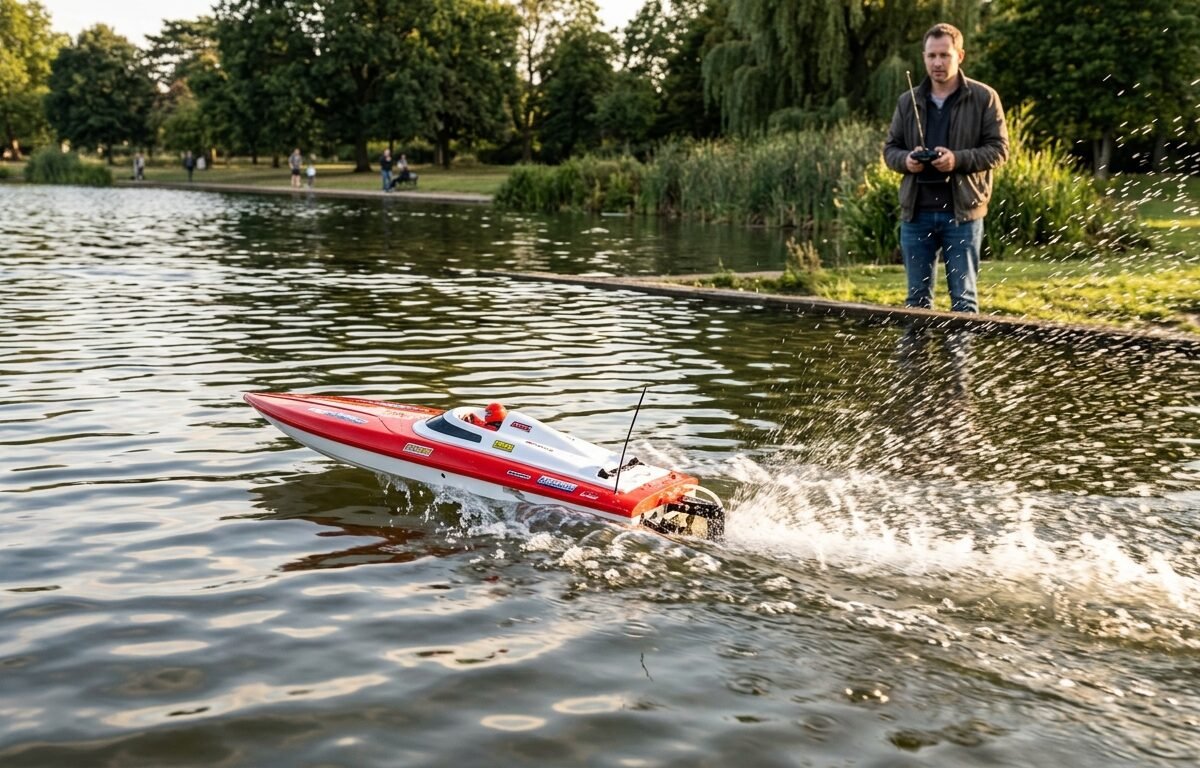
Remember the language quirk from the introduction: barca means “boat” in Spanish and Italian. European hobby shops sell ready-to-run RC boats with names like “barca RC,” and those pages rank for the same keyword. If the listing shows a hull, a propeller, and a 700mm length, you are looking at an RC boat — a completely different hobby with different skills, venues, and maintenance. Fun in its own right, but not what this guide covers. Now you know how to tell them apart at a glance.
Frequently Asked Questions
Is the Exceed RC Barca good for beginners?
It is good for beginners to gasoline RC, but not great as a very first RC car. If you have never driven any RC vehicle, start with a ready-to-run electric 1/10-scale truck, which is cheaper, quieter, and far more forgiving. If you already drive electric RC and want to step into large-scale gas power, the Barca is a reasonable entry point because it arrives assembled with the radio included.
How fast is the Barca?
Exceed RC does not publish an official top-speed figure. Sellers describe it as one of the faster ready-to-run 1/5-scale buggies, and third-party listings for this class of 30cc gas buggy commonly cite speeds in the 40 mph (roughly 65 km/h) neighborhood. Real-world speed depends on gearing, tuning, tires, and surface. Treat any exact number on a random listing with skepticism.
What fuel does it use?
Unleaded gasoline mixed with two-stroke oil at the ratio specified in the manual. Do not use straight gasoline — a two-stroke engine gets its lubrication from the oil in the fuel, and running it without oil will destroy the engine quickly.
How long does a tank of fuel last?
Run time varies with driving style, but gas buggies in this class typically run 30 to 45 minutes per tank of spirited driving. Refueling takes a minute, so total session length is limited by your receiver battery and your enthusiasm, not by charging.
30cc or 32cc — does it matter?
Only slightly. The 32cc has a bit more torque, but the chassis, drivetrain, radio, and maintenance are the same. Buy on condition and price rather than engine displacement.
Can I drive it in my backyard?
Probably not, unless your backyard is enormous. The Barca needs a large open area, and it is loud enough to bother neighbors. Find a local RC track or club field instead — your neighbors and your buggy will both thank you.
What breaks first?
On any large-scale basher, the usual suspects are the pull starter cord, the air filter (from neglect, not defect), spur gears after bad landings, and whatever screw you forgot to check. Keep spares of the consumables and check fasteners religiously, and the car will treat you well.
Read Also: 2026 Dodge Durango: Prices, Trims, Towing & the 710-HP Hellcat (Complete Guide)
Related Stories

Lola Dolls (2026): Complete Guide to the L.O.L. Surprise! Lola Toy Line
Everything parents, gift-buyers and collectors need to know about Lola dolls from L.O.L. Surprise! — from spotting fakes…