How to Buy a House in 2026: A Step-by-Step Guide for First-Time Buyers
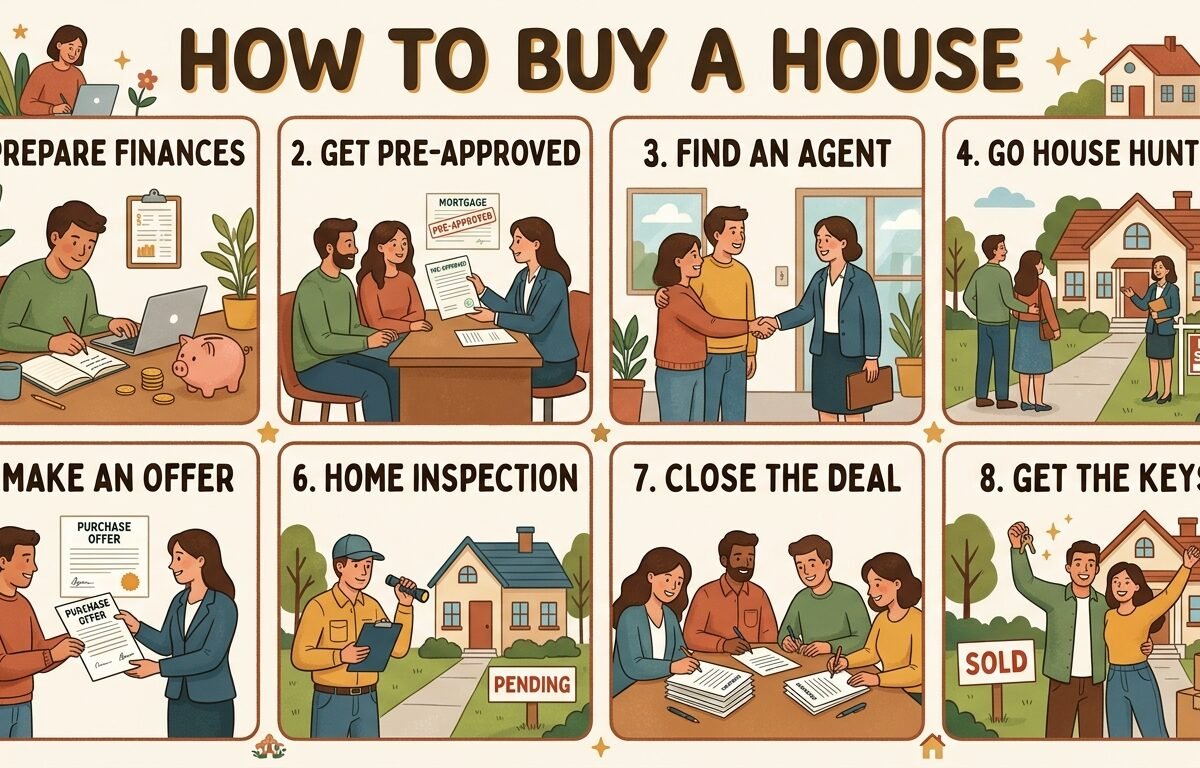
How to Buy a House: The Real Step-by-Step Guide for 2026
Nobody sits you down in school and explains how to buy a house. One day you’re paying rent, the next day a friend buys a place and you’re nodding along while they talk about “earnest money” and “escrow” like it’s supposed to make sense. It doesn’t — not at first.
Here’s the good news: buying a house is a process, and processes can be learned. There are about ten steps, they happen in a specific order, and most of the expensive mistakes people make come from doing them out of order — like falling in love with a house before knowing what they can afford.
This guide walks you through the entire journey in the order it actually happens: figuring out your budget, fixing your credit, saving the down payment, getting pre-approved, finding an agent, hunting, offering, inspecting, and closing. No jargon without explanation, no skipped steps, and a few hard-won lessons that cost real buyers real money.
The short version: buying a house in the U.S. typically takes 4 to 8 months and follows a fixed sequence — check your credit, set your budget, save for the down payment and closing costs, get pre-approved, shop with an agent, make an offer, pass inspection and appraisal, then close. Almost nothing costs you money until you’re under contract, so the free early steps are the ones that decide everything.

What Does It Actually Take to Buy a House?
Before the steps, a realistic picture of what the journey looks like — in time and money — helps more than anything.
| Stage | Typical Time | What It Costs You |
|---|---|---|
| Credit and budget prep | 1–6 months | Nothing |
| Pre-approval | 1–3 days | Nothing (one credit inquiry) |
| House hunting | 4–12 weeks | Nothing |
| Offer and contract | 3–10 days | Earnest money deposit (1–3% of price, held in escrow) |
| Inspection and appraisal | 1–3 weeks | $500–$1,500 |
| Underwriting to closing | 30–45 days | Down payment + closing costs |
Notice something important: nearly everything before the offer is free. The buyers who get burned are usually the ones who rushed the free steps — guessing at their budget, skipping pre-approval — and then paid for it later with a denied loan or a house they couldn’t comfortably afford.
Step 1: Get Honest About What You Can Afford
This is the step people want to skip, and it’s the step that matters most. “What can I afford?” has two answers: what a bank will lend you, and what you can comfortably pay. They are not the same number, and the second one is the one that decides whether homeownership feels like freedom or a trap.
Lenders use a guideline called the 28/36 rule. Your total housing payment — mortgage, property taxes, insurance, and any HOA fees — shouldn’t exceed about 28% of your gross monthly income, and your total debts (housing plus car loans, student loans, credit cards) shouldn’t exceed about 36%. So on a $75,000 salary ($6,250/month), the housing ceiling is roughly $1,750 a month.
But here’s what the rule doesn’t capture: a lender doesn’t know your childcare costs, your commute, or how much travel and fun money keeps you sane. Many buyers deliberately set their budget 10–15% below the maximum a lender approves. Houses come with surprise expenses — a water heater doesn’t care about your debt-to-income ratio. Build a buffer into the budget from day one.
Do a quick self-check before anything else
- Add up your gross monthly income and multiply by 0.28 — that’s a rough housing ceiling.
- Subtract your actual monthly debts and non-negotiable expenses.
- Ask yourself: if the payment were $200 higher than expected, would I still be comfortable?

Step 2: Check Your Credit and Give It Time If It Needs It
Your credit score is the single biggest lever on the cost of your mortgage. A better score doesn’t just mean approval — it means a lower interest rate, and even a fraction of a percent difference can save tens of thousands of dollars over a 30-year loan.
Know the rough tiers:
- 580+ — minimum for an FHA loan with 3.5% down
- 620+ — minimum most conventional lenders want to see
- 700+ — where the meaningfully better rates start appearing
- 740–760+ — typically the best available rates
You can check your score for free through services like Credit Karma or Experian — a soft check won’t hurt your score. Then look at the report itself, not just the number. Dispute errors, pay down high credit card balances (keeping utilization under about 30% of limits helps), and avoid opening new lines of credit in the months before you apply. A new car loan right before a mortgage application is one of the classic self-inflicted wounds.
If your score needs work, that’s fine — but it’s a reason to wait a few months, not to push ahead anyway. Improving from 640 to 720 can change your monthly payment by hundreds of dollars. That’s worth a delay.
Step 3: Save for the Down Payment and Closing Costs
This is where most buyers get stuck — or worse, get a wrong idea stuck in their head. The myth that you need 20% down stops more people from buying than almost anything else. You don’t need 20%. Many buyers put down far less.
What you actually need for a down payment
- Conventional loan: as little as 3% down for qualified buyers (programs like Fannie Mae’s HomeReady and Freddie Mac’s Home Possible target low-to-moderate income buyers). 20% down is only required if you want to avoid private mortgage insurance (PMI).
- FHA loan: 3.5% down with a credit score of 580 or higher; 10% down with scores between 500 and 579.
- VA loan: 0% down for eligible veterans, active-duty service members, and some surviving spouses — and no monthly mortgage insurance.
- USDA loan: 0% down in eligible rural and suburban areas, with income limits.
On a $300,000 house, that means $9,000 down on a 3% conventional loan or $10,500 on an FHA loan — not $60,000. Less down means a higher monthly payment and mortgage insurance costs, but PMI on conventional loans drops off once you reach 20% equity, so it doesn’t have to be permanent.
Don’t forget the closing costs
The down payment isn’t the only check you write. Closing costs — lender fees, title insurance, appraisal fees, recording fees, prepaid taxes and insurance — typically run 2% to 5% of the purchase price. On a $300,000 home, budget another $6,000 to $15,000. Some buyers negotiate for the seller to cover part of these (called seller concessions), but plan as if you won’t get them.
Down payment assistance exists — most buyers never look
Nearly every state runs down payment assistance programs through its housing finance agency — grants that never need repaying, forgivable second mortgages, and low-interest loans. These often stack with FHA or conventional loans. A quick search of your state’s housing finance agency website (or hud.gov) is one of the highest-value hours you’ll spend in this process.
Step 4: Get Pre-Approved for a Mortgage
Pre-approval is a lender’s written estimate of how much they’ll lend you, based on a real review of your income, credit, debts, and employment. It’s free, takes a day or two, and changes everything about house hunting: you know your real budget, and sellers take your offer seriously.
Pre-approval is not pre-qualification. Pre-qualification is a rough guess from self-reported numbers. Pre-approval means the lender actually verified documents. In competitive markets, an offer without a pre-approval letter barely registers.
How to do it well
- Shop at least 3 lenders — banks, credit unions, and mortgage brokers. Rates and fees vary more than people expect, and a single afternoon of comparison can save thousands.
- Gather your documents first: recent pay stubs, W-2s or tax returns, bank statements, ID, and a list of debts. Lenders ask for all of it.
- Don’t make big financial moves between pre-approval and closing: no new credit cards, no large unexplained deposits, no job changes if you can avoid it. Lenders re-verify before funding.
Pre-approval letters usually expire after 60–90 days. That’s fine — you can renew. Just don’t let it expire mid-offer.
Step 5: Find a Good Real Estate Agent
You can buy without an agent, but for a first purchase, a good buyer’s agent earns their keep — and in most U.S. transactions, the seller pays the commissions, so the buyer typically pays nothing out of pocket for representation. (Commission structures have shifted in recent years, so confirm the arrangement in writing with your agent before you start touring.)
A good agent does three things a website can’t: they get you into homes fast in competitive markets, they tell you what a house is actually worth before you offer, and they negotiate the terms that matter — price, repairs, closing timeline, contingencies — not just the headline number.
Interview at least two or three agents. Ask how many buyers they’ve represented in your target neighborhoods in the last year, how they handle bidding wars, and how they communicate. The agent who pressures you to waive the inspection “to win” is telling you who they work for — and it’s not you.

Step 6: Start House Hunting (With a System)
This is the fun part, but it goes sideways fast without discipline. Before touring, write down your must-haves versus nice-to-haves — bedrooms, commute, school district, lot size — and the absolute dealbreakers. Bring the list to every showing. After the fifth house, they all blur together; the list is your memory.
A few practical rules from buyers who learned the hard way:
- Tour at different times. A quiet street at noon can be a shortcut for commuters at 5 p.m. Drive by in the evening and on a weekend.
- Look past the staging. Paint and furniture are cheap; location, layout, roof age, and foundation are not. Ask about the age of the roof, HVAC, and water heater — these are five-figure replacements.
- Research the neighborhood like a local. Check flood maps, crime data, school ratings, HOA rules and fees, and planned developments nearby. An HOA with a $400 monthly fee changes your budget math.
- Don’t fall in love at the top of your budget. If you need everything to go perfectly for the numbers to work, the numbers don’t work.
Step 7: Make an Offer and Negotiate
When you find the one, your agent drafts a purchase offer — price, earnest money deposit (typically 1–3% of the price, held in escrow to show you’re serious), contingencies, and a closing timeline. In a balanced market you might offer at or below asking; in a hot market, above asking with an escalation clause is common. Your agent’s read on local conditions matters more here than any national rule of thumb.
Contingencies are your safety net. The big three:
- Inspection contingency — lets you back out or renegotiate if the inspection reveals problems.
- Appraisal contingency — protects you if the home appraises below the offer price.
- Financing contingency — lets you exit if your mortgage falls through.
Waiving contingencies makes an offer stronger, but each one you waive is a risk you personally absorb. First-time buyers should be very cautious about waiving the inspection — it’s the cheapest insurance in the entire process.
Step 8: Get the Home Inspected and Appraised
Once your offer is accepted, two evaluations happen — and they serve different masters.
The home inspection ($300–$500 typically) is for you. A licensed inspector spends a few hours examining the roof, foundation, plumbing, electrical, HVAC, and appliances, then hands you a detailed report. No house is perfect — expect a list. What you’re looking for are the expensive structural, safety, and system issues: foundation cracks, mold, faulty wiring, a failing roof. You can then negotiate repairs, a price reduction, or credits — or walk away if the problems are severe and your contingency allows it.
The appraisal is for your lender. They need an independent opinion that the home is worth what they’re lending. If it appraises below your offer price, you have options: renegotiate the price, cover the gap in cash, or walk away (if your appraisal contingency is intact). A low appraisal isn’t the end of the world — it’s information. Treat it that way.
Step 9: Line Up Homeowners Insurance
Your lender will require homeowners insurance before closing — no policy, no loan. Shop this like you shopped the mortgage: get at least three quotes, because premiums for identical coverage vary wildly. Make sure the policy covers the home’s replacement cost, not just its market value, and check whether you need separate flood or earthquake coverage — standard policies typically exclude both.
Do this early in the underwriting window, not the week of closing. Insurance shopping is one of those tasks that feels skippable until it’s suddenly urgent.
Step 10: The Final Walkthrough and Closing Day
You’re almost there. In the last 24–48 hours before closing, do a final walkthrough: confirm the house is in the agreed condition, that negotiated repairs were actually completed, and that nothing was damaged during the seller’s move-out. Bring your inspection report and the repair agreement. If something’s wrong, flag it before you sign — after closing, it’s your problem.
Closing day is the paperwork marathon. You’ll sign the mortgage note, the deed of trust or mortgage, the closing disclosure (which you should receive at least three business days before closing — read it, and question any fee that moved since the loan estimate), and a stack of other documents. Bring a cashier’s check or arrange a wire for your down payment and closing costs, plus photo ID.
Then the funds are disbursed, the deed is recorded, and you get the keys. The whole appointment usually takes one to two hours. After months of work, it’s oddly anticlimactic — and wonderful.
Common Mistakes That Cost Buyers Thousands
Most of these come from experienced agents and loan officers who’ve watched buyers learn them the expensive way:
- House hunting before pre-approval. You tour homes you can’t afford, or lose the right one because your offer wasn’t credible.
- Draining savings for the down payment. Keep an emergency fund of 3–6 months of expenses after closing. The furnace doesn’t care that you just bought a house.
- Ignoring the true monthly cost. Mortgage principal and interest are only part of it — add property taxes, insurance, PMI, HOA fees, and roughly 1% of the home’s value per year for maintenance.
- Making big financial changes mid-process. New debt, job changes, or large undocumented deposits can derail underwriting days before closing.
- Skipping the inspection to “win” a bidding war. Saving a deal by skipping a $400 inspection is how you inherit a $15,000 foundation problem.
- Not shopping lenders and insurers. One quote is a guess. Three quotes are a market.
- Buying at the absolute top of the approved budget. Lenders approve maximums, not comfort levels. Leave breathing room.
How Long Does the Whole Process Take?
From decision to keys, most buyers spend 4 to 8 months. The breakdown: credit and budget prep (1–6 months, free), house hunting (4–12 weeks, free), and the contract-to-close stretch (30–45 days once your offer is accepted). If your credit and savings are already in shape, you can compress the front end significantly. The contract-to-close timeline is the least flexible part — underwriting, appraisal, and title work simply take the time they take.
Is 2026 a Good Time to Buy a House?
Honest answer: it depends on your local market and your personal timeline, not on national headlines. What matters more than timing the market:
- How long you’ll stay. Buying usually beats renting if you’ll stay 5–7+ years, because transaction costs (closing costs now, selling costs later) need time to amortize.
- Your local price-to-rent ratio. In some cities renting is far cheaper than owning; in others they’re close. Run the numbers for your actual zip code.
- Your financial readiness. Stable income, manageable debt, emergency fund intact, and a down payment saved — these matter more than any market forecast.
- Rates are refinanceable; prices are not. If you buy at today’s rate and rates fall, you can refinance. You can’t retroactively lower the purchase price.
Nobody can reliably predict where prices or rates go next. Buy when your numbers work and you plan to stay — that’s the timing strategy that has survived every market cycle.
FAQs
How much money do I need to buy a house?
More than the down payment, less than you fear. Plan for the down payment (3–20% depending on loan type), closing costs (2–5% of the price), and an emergency fund of 3–6 months of expenses left over after closing. On a $300,000 home with 5% down, that’s roughly $15,000 down + $6,000–$15,000 closing + your emergency reserve.
What credit score do I need to buy a house?
There’s no single number. FHA loans go down to 580 (3.5% down) or even 500–579 (10% down); most conventional loans want 620+; VA and USDA loans don’t set a formal minimum but lenders typically want around 620. Higher scores earn better rates at every tier.
Do I really need 20% down?
No. Twenty percent down avoids private mortgage insurance on conventional loans, which is valuable — but conventional loans allow as little as 3% down, FHA allows 3.5%, and VA/USDA allow zero. Waiting years to save 20% while prices and rents rise can cost more than paying PMI for a while.
Should I buy a house now or wait?
Buy when your personal numbers work: stable income, manageable debt, down payment and emergency fund saved, and plans to stay put for at least 5 years. Timing the market is unreliable; being financially ready is not.
What’s the difference between pre-approval and pre-qualification?
Pre-qualification is a rough estimate from self-reported numbers. Pre-approval means a lender verified your income, credit, and debts and committed to a loan amount in writing. Sellers treat pre-approval as serious; pre-qualification as a guess.
How much are closing costs?
Typically 2–5% of the purchase price — lender fees, title insurance, appraisal, recording fees, and prepaid taxes and insurance. On a $400,000 home, expect $8,000–$20,000. You’ll see the itemized total on your closing disclosure at least three business days before closing.
Can I buy a house with no money down?
Possibly. VA loans (eligible veterans/service members) and USDA loans (eligible rural areas) require 0% down. FHA and conventional low-down-payment loans can combine with state down payment assistance grants to get your out-of-pocket cost close to zero. You’ll still need to cover or negotiate closing costs.
Read Also: Barca Radio Control: Complete Guide to the Exceed RC Barca 1/5 Gas Buggy (2026)
1 response