What Is the Earth’s Shape? A Simple 2026 Guide
Earth is not a perfect sphere. It is an oblate spheroid — slightly flattened at the poles and bulging at the equator — and scientists have known this for centuries through measurements, eclipses, and photos from space.
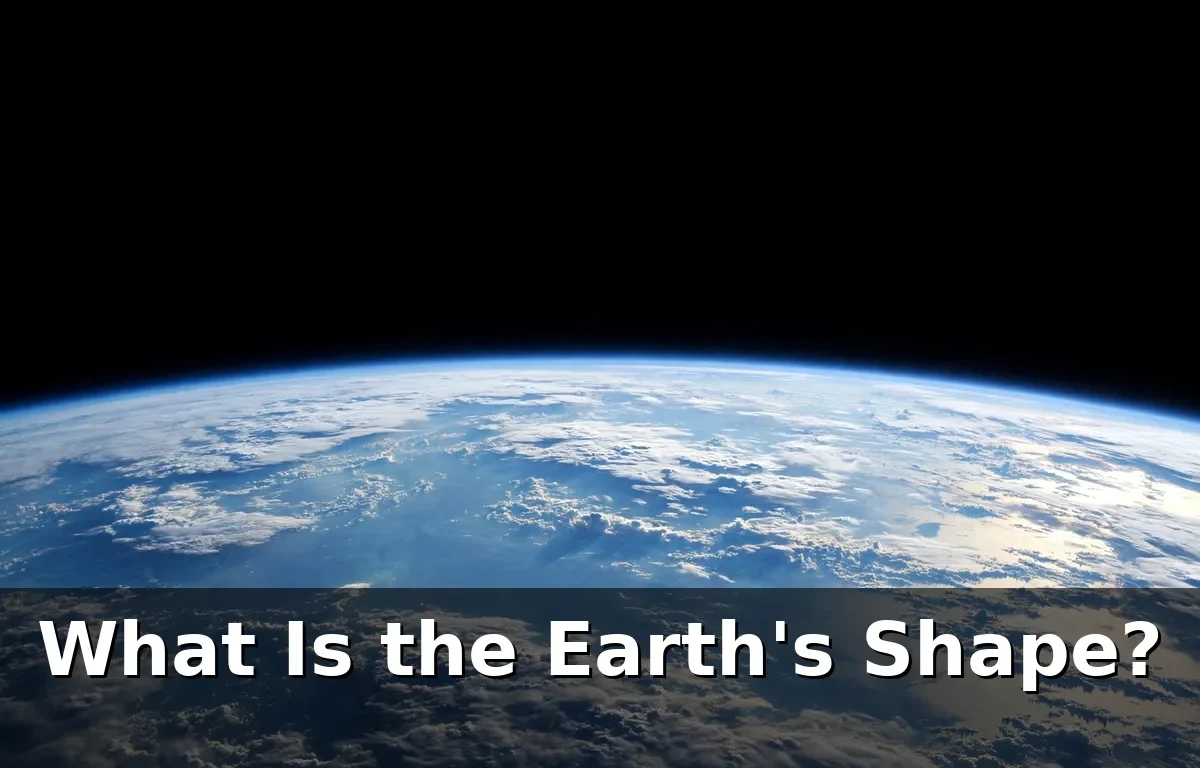
The short version: what is the Earth’s shape? Earth is an oblate spheroid. That is the scientific name for a sphere squashed very slightly at the top and bottom, so it bulges a little around the middle. It is round, but it is not a perfect ball.
The difference is small enough that you would never notice it on a classroom globe. Yet it is large enough for scientists to measure, and it matters for navigation, mapping, and satellites. If you want one sentence to remember, here it is: Earth is round, a little wider around the equator than from pole to pole, and shaped by its own spin.
The science is not new. Sailors, astronomers, and surveyors worked out that Earth is round more than two thousand years ago, and later measurements showed it is slightly flattened.
The Short Answer: What Is the Earth’s Shape?
An oblate spheroid is a sphere pressed gently at the poles. The result is wider across the equator and shorter from the North Pole to the South Pole. Earth fits that description very well.
The numbers tell the story clearly. The diameter through the equator is about 12,756 kilometres. The diameter from pole to pole is about 12,714 kilometres. The difference is roughly 42 kilometres — about one part in three hundred on a planet more than 12,700 kilometres across. It is real and measurable, but tiny in everyday terms.
The circumference around the equator is about 40,075 kilometres. A journey around the planet through the poles would be a little shorter, because that route is slightly squashed. Mapmakers and satellite operators take this difference into account, even though it is invisible to the naked eye.
It helps to picture Earth as a ball that is almost, but not quite, perfect. If you shrank it to the size of a basketball, the flattening would be less than the thickness of a sheet of paper.
What “Oblate Spheroid” Actually Means
The word “oblate” means flattened at the poles. A spheroid is a shape like a sphere, but stretched or squashed in one direction. Put the two words together and you get a sphere squashed from top to bottom.
Picture a ball of soft dough spinning on a turntable. As it spins, the material moves outward around the middle, and the top and bottom flatten slightly. Earth does the same thing, far more slowly: its daily spin pushes material outward at the equator.
That is also why the equator is the widest part of the planet. At the equator, the surface moves fastest as Earth turns, so the outward effect is strongest there. At the poles, the surface barely moves at all, because the poles sit on the axis of rotation. The result is a gentle bulge around the middle and a gentle flattening at the ends.
‘Oblate spheroid’ is a model of what is the Earth’s shape, not a description of every hill and valley. The spheroid is the smooth shape that fits the planet best overall, and scientists use it as a reference.
Earth by the Numbers
These are the standard textbook figures. The equatorial diameter is about 12,756 kilometres, and the polar diameter about 12,714 kilometres. The equatorial radius is about 6,378 kilometres, the polar radius about 6,357 kilometres, and the equatorial circumference about 40,075 kilometres.
These numbers come from ground surveys, gravity readings, and satellite tracking, and they agree closely. If one method gave a very different answer, that would be a warning sign. Instead, they converge on the same answer to what is the Earth’s shape: a slightly flattened sphere.
Jupiter and Saturn spin much faster than Earth, and they are much more flattened. Saturn is visibly oblate even in a small telescope. Earth spins more slowly, so its flattening is far more subtle.
Sphere vs Oblate Spheroid vs Geoid
Three words often get mixed up here: sphere, oblate spheroid, and geoid. They describe three levels of detail, and it helps to keep them separate.
| Shape | What it means | How well it fits Earth |
|---|---|---|
| Sphere | A perfectly round ball, the same distance from the centre to every point on the surface | A good first approximation, but not exact |
| Oblate spheroid | A sphere squashed slightly at the poles and bulging at the equator | A very good fit for the overall shape of Earth |
| Geoid | The lumpy, uneven surface that sea level would follow if there were no winds, tides, or currents | The most detailed model, used for precise height measurements |
A sphere is the simplest model. For many everyday purposes, it is good enough — for a rough map, or for explaining the day-night cycle to a child. The error is only about one part in three hundred, invisible on a classroom globe.
An oblate spheroid is the next step up in accuracy. It captures the flattening caused by rotation, and it is the shape used for most mapping and navigation. When your phone calculates your position, the system behind it uses this model, not a perfect sphere.
The geoid is the most detailed of the three. It is the shape the oceans would take if they were perfectly still, responding only to gravity and rotation. Because gravity is slightly stronger in some places, the geoid has gentle bumps and dips, and sea level follows it, not the smooth spheroid.
In short, the sphere is the simple answer to what is the Earth’s shape, the oblate spheroid is the accurate answer, and the geoid is the precise answer. None of them contradicts the others. They are the same planet described at different levels of detail.
How We Know the Shape
Scientists did not settle the question — what is the Earth’s shape? — in a single experiment. The picture built up over centuries, with each new method confirming what came before. Here is how it happened, step by step.
Step 1: Eratosthenes Measures the Curve
More than two thousand years ago, the Greek scholar Eratosthenes noticed that at noon on the summer solstice, the Sun shone straight down a well in Syene, in southern Egypt, casting no shadow — while a vertical stick in Alexandria, farther north, did cast one. That could only happen on a curved surface, and from the shadow’s angle he worked out Earth’s circumference — an early answer to what is the Earth’s shape — remarkably close to the modern value.
Step 2: Ships Disappear Hull First Over the Horizon
When a ship sails away from shore, it disappears from the bottom up: the hull goes first, then the deck, then the mast. That pattern only makes sense on a curved surface, where the curve of Earth hides the lower parts first. Anyone who has watched a ship leave a harbour on a clear day has seen it.
Step 3: Lunar Eclipses Always Show a Round Shadow
A lunar eclipse happens when Earth passes between the Sun and the Moon, casting its shadow on the Moon. That shadow is always round, from every angle. A flat disc could cast a round shadow only when facing the Sun and Moon just right; a sphere always does. Ancient astronomers understood this, and it became a standard proof of what is the Earth’s shape.
Step 4: Photographs From Space
The most direct evidence came in the twentieth century, when cameras went above the atmosphere. Photographs from space show what is the Earth’s shape: a round planet with a curved horizon and a thin blue atmosphere, from the Apollo 17 ‘Blue Marble’ of 1972 to modern weather satellites.
Step 5: Gravity Measurements and Satellites
The most precise modern measurements come from gravity and satellites. Gravity is slightly weaker at the equator than at the poles, because the equator is farther from Earth’s centre and the spin there partly counteracts gravity. Satellite orbits confirm it: tracking them precisely reveals what is the Earth’s shape.
Why Earth Is Not a Perfect Sphere
If gravity pulls everything toward the centre, you might expect a perfect sphere — and ask what is the Earth’s shape, if not that. The reason it is not comes down to rotation. Earth spins once a day, and anything on the equator is carried around a circle about 40,075 kilometres long every 24 hours, at roughly 1,670 kilometres per hour.
Over time, the planet’s material responded to that outward push by settling into a slightly flattened shape. Rock can flow, very slowly, under sustained force. The balance between gravity pulling inward and rotation pushing outward sets the final answer to what is the Earth’s shape, and any spinning body that can deform will bulge at its equator.
The Geoid and Sea Level
Sea level is often treated as a fixed reference, but it is really a surface that follows the geoid — the lumpy version of what is the Earth’s shape. If the oceans were perfectly still, with no wind, tides, or currents, their surface would settle into the shape where gravity is the same everywhere along it.
The geoid is close to the oblate spheroid — the simple model of what is the Earth’s shape — but not identical. In some places it rises above the spheroid by tens of metres; in others it dips below it, reflecting variations in the density of rock deep inside Earth. Mountain heights are measured above sea level — above the geoid — while GPS usually reports height above the spheroid model.
Why Earth Looks Flat From the Ground
You may know what is the Earth’s shape and still wonder why it looks flat when you stand outside. The answer is scale. Earth is enormous compared with a person, and over the small patch you can see, the curve is extremely gentle. The ground feels flat because the change in height across that distance is very small.
The horizon itself is evidence of the curve — and of what is the Earth’s shape. It is the line where the surface curves away from your line of sight, and it sits farther away the higher you climb. From an aeroplane window at cruising altitude, around ten kilometres up, the curve of the horizon is visible on a clear day.
Common Myths About What Is the Earth’s Shape
The first myth is that people believed Earth was flat until a single voyage proved otherwise. In reality, educated people in the ancient Mediterranean world already knew Earth was round: Greek scholars had measured its size, and Roman writers described it as a sphere.
The second myth is that Earth is a perfect sphere. It is close, but the measurements point to a slight flattening. Saying Earth is a sphere is a useful simplification, but it is not the full answer to what is the Earth’s shape. The oblate spheroid is the more accurate description.
The third myth is that the flattening matters in daily life. It does not. The difference of about 42 kilometres is spread across the whole planet. It matters for satellites, long-distance navigation, and precise mapping, and for little else.
The fourth myth is that one observation, such as a single photograph, settles the question. Science combines many independent lines of evidence — ancient measurements, ships on the horizon, lunar eclipses, photographs, gravity readings, and satellite orbits — into a consistent picture of what is the Earth’s shape.
FAQs
Is Earth round or flat?
Earth is round. More precisely, to answer what is the Earth’s shape: it is an oblate spheroid — round but slightly flattened at the poles and wider at the equator. The evidence includes ships disappearing hull first over the horizon, the round shadow of Earth during lunar eclipses, photographs from space, and precise gravity and satellite measurements.
What is an oblate spheroid in simple words?
An oblate spheroid is a sphere squashed slightly from top to bottom, so it bulges around the middle. Think of a ball pressed gently at the North and South Poles. That is the shape Earth has, because its daily spin pushes material outward at the equator.
How much wider is Earth at the equator than at the poles?
The equatorial diameter is about 12,756 kilometres, and the polar diameter is about 12,714 kilometres. The difference is roughly 42 kilometres, about one part in three hundred. That is why Earth looks perfectly round on a globe and in most photographs, even though you now know what is the Earth’s shape.
Why is Earth not a perfect sphere?
Earth spins once a day, and that spin creates an outward push that is strongest at the equator. Over time, the planet settled into a shape that balances gravity pulling inward and rotation pushing outward. The result is a slight equatorial bulge and a slight flattening at the poles.
What is the geoid?
The geoid is the lumpy surface that sea level would follow if the oceans were perfectly still and responded only to gravity and rotation. It is very close to the oblate spheroid, but it has gentle bumps and dips of tens of metres caused by uneven masses of rock inside Earth. Surveyors use it as the reference for measuring heights above sea level — a practical use of knowing what is the Earth’s shape.
Why does Earth look flat when I stand on it?
Earth looks flat because it is so large compared with a person. The curve over the distance you can see is extremely gentle, and local hills, trees, and buildings hide it easily. The horizon moves farther away as you climb higher, which is exactly what you expect when you know what is the Earth’s shape, and from an aeroplane window the curve becomes visible on a clear day.
Conclusion
What is the Earth’s shape? Earth is an oblate spheroid: round, slightly flattened at the poles, and bulging at the equator. The equatorial diameter is about 12,756 kilometres, the polar diameter about 12,714 kilometres, and the equatorial circumference about 40,075 kilometres. We know this from Eratosthenes, ships on the horizon, lunar eclipses, photographs from space, and satellites.
Related Stories

Voddler.co.uk: What It Is and How to Use the Site
What is Voddler.co.uk? The honest story of the old Voddler streaming service, what the .co.uk search means today,…
860 Area Code: Location, Cities and How to Dial It
Wondering where the 860 area code is? It covers northern and eastern Connecticut, including Hartford. Learn how to…

Telemetryczny Meaning, Telemetry Explained In English
Telemetryczny is a Polish adjective meaning relating to telemetry, the remote measurement and transmission of data. This guide…
1 response